1

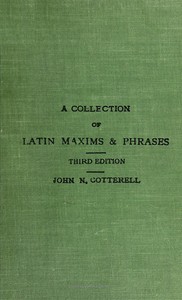
A collection of Latin maxims and phrases literally translated Intended for the use of students for all legal examinations — Reading Companion
(0 User reviews)
635
Project Gutenberg
2022
Not confirmed
Latin language; Legal maxims
Readers of public-domain and historical texts
Project Gutenberg digital edition
en
Edition facts
Words
19,340
Reading time
85 min
Text sections
6
The catalog record for A collection of Latin maxims and phrases literally translated Intended for the use of students for all legal examinations — Reading Companion provides practical reading context through 19,340 words, 1 hr 25 min estimated reading time, and 6 detected text sections.
The text analysis averages about 13.4 words per sentence, while the detected sections provide another way to judge how the source is divided.
Project Gutenberg metadata also associates the work with “Latin language,” connecting these edition facts with the source record’s subject description.
Source:
Project Gutenberg record #68465
A reference work collecting Latin legal maxims with literal translations, brief explanations, and case references, compiled by a solicitor for law students preparing for examinations.
Read the complete public-domain text at its original source.
Read on Project GutenbergJohn N. Cotterell, a solicitor and notary public, compiled this collection of Latin maxims and phrases specifically for students facing legal examinations. The work, first published in 1881 and reaching a third edition by 1913, reflects a practical study aid shaped by the author's own experience. Cotterell notes in the preface that he became convinced of the advantage of knowing leading Latin maxims during his own reading for intermediate and final exams. The maxims are drawn from recognized examination textbooks, with explanations kept brief and leading cases referenced for deeper study.
Purpose and Structure
Cotterell's preface makes clear the book's targeted function: to supply maxims that 'occur in the recognised examination text-books' and that are 'constantly met with by the student.' He advises committing them to memory, likening their importance to that of leading cases. The maxims are numbered sequentially, each with a Latin phrase, a literal English translation, and a concise explanatory note. Many entries also cite legal authorities such as Chitty on Contracts or Miller v. Race, and cross-reference other maxims by number. This structure allows the student to move quickly between related principles, such as the pair Necessitas non habet legem and Necessitas vincit legem (maxims 158–159).
Recurring Doctrinal Threads
Several legal doctrines appear repeatedly across the maxims. Estoppel, for instance, is illustrated by Nemo contra factum suum venire potest (no one can go against his own deed) and is linked to the principle that a person cannot change his purpose to another's injury (Nemo potest mutare consilium suum). The concept of impossibility surfaces in Nemo tenetur ad impossibile (no one is bound to an impossibility), which distinguishes physical impossibility from subsequent impossibility. Criminal law principles such as double jeopardy (Nemo debet bis punari pro uno delicto) and the privilege against self-incrimination (Nemo tenetur seipsum prodere) are also treated. These threads give the collection a coherence beyond a mere alphabetical list.
The Author's Voice and Context
Cotterell's prefaces reveal a personal dimension. In the first edition he writes from the perspective of a student who 'in all distrust and doubtfulness' approached the law. By the second and third editions, after 'a busy and practical experience of many years,' he speaks with more authority, yet still acknowledges the law's complexity, quoting Tennyson's phrase 'the lawless science of our law, that codeless myriad of precedent.' He also observes that periods of war produce little legislation, while domestic legislation indicates peaceful administration. These asides, though brief, give the reader a sense of the compiler's own intellectual journey and his view of law as an intricate, ever-changing study.
Cotterell's collection is best used as a companion to systematic legal study rather than as a standalone text. The maxims are arranged for quick reference, but the cross-references invite the reader to explore connections between principles. Students may find it helpful to read the explanatory notes alongside the primary sources cited, such as Broom's Legal Maxims, which Cotterell recommends for deeper research. The book's value lies in its distillation of frequently tested material into a portable format.
Holding this volume, I’m back in a dim study, tracing each Latin phrase like a stone threshold. It reminded me of another quiet afternoon with Magna Carta, and Other Addresses — Reading Notes, where old words felt less like rules and more like slow, patient footsteps through a corridor of centuries, each one asking me to pause and listen.
There are no reviews for this eBook.
There are no comments for this eBook.
Reader reflection
How will you remember this book?
Save your reaction, strongest insight, and memorable passage.
Your progress
0
/
10
2
How did the book work for you overall?
3
Would you recommend this book to another reader?
4
What was the reading difficulty like?
5
Would you like to discuss this book with someone?
6
Which aspect of the book did you value most?
7
Was the book what you thought it would be?
8
Do you expect to return to this book?
9
What is the main idea you are taking away?
10