1

Marriage and Divorce Laws of the World — Edition Insights
(0 User reviews)
1501
Project Gutenberg
2011
Not confirmed
Marriage law; Divorce -- Law and legislation
Readers of public-domain and historical texts
Project Gutenberg digital edition
en
Edition facts
Words
68,273
Reading time
297 min
Text sections
8
Before opening Marriage and Divorce Laws of the World — Edition Insights, the edition data offers a quick orientation: 68,273 words, 4 hr 57 min estimated reading time, and 8 detected text sections.
The text analysis averages about 20.5 words per sentence, while the detected sections provide another way to judge how the source is divided.
Project Gutenberg metadata also associates the work with “Marriage law,” connecting these edition facts with the source record’s subject description.
Source:
Project Gutenberg record #35760
A 1911 comparative law reference by Hyacinthe Ringrose, surveying marriage and divorce statutes across principal nations. The preface frames marriage as civilization's keystone while disclaiming reformist intent. Excerpts detail Islamic prohibitions, polygamy limits, and the Nikah ceremony, revealing the work's method of presenting positive law without advocacy.
Read the complete public-domain text at its original source.
Read on Project GutenbergHyacinthe Ringrose's 1911 compilation opens with a striking paradox: the preface insists the book is 'not a brief in favour of, or against, any particular social system or legal code,' yet immediately declares marriage 'the keystone of civilization' and monogamy 'the one triumphant fact of human history.' This tension between dispassionate reference and moral conviction runs throughout the work. Ringrose, a Doctor of Civil Law who had searched the British Museum and Bibliothèque Nationale for such a volume, positions his book as the first of its kind—a practical summary for lawyers, legislators, and sociologists. The excerpts show a methodical structure: after a general preface, the text moves into specific national or religious systems, with the Islamic law section offering detailed prohibitions, polygamy rules, and the Nikah ceremony. The editor's voice emerges most clearly in the preface's closing claim that 'that nation is most enlightened which treats its womankind the best,' a value judgment that sits uneasily with the stated goal of simply setting forth 'positive law as it exists to-day.'
The Editor's Moral Framework
Ringrose's preface reveals a deliberate rhetorical strategy. He asserts that 'modernity brings uniformity in every department of public and private law' and that 'the wholesome view of marriage as the union of one man and one woman for life' is 'the one triumphant fact of human history.' These are not neutral observations but ideological claims, especially given the book's subject matter includes polygamous systems. The editor further states that 'woman everywhere is more and more being allowed her natural place in the community as man's equal and associate,' linking legal progress to gender equality. Yet he immediately hedges: the book 'has not a mission to assist in the reformation of any country's marriage and divorce law.' This creates a persistent ambiguity—is the work a disinterested reference or a subtle argument for Christian monogamy? The excerpts do not resolve this, but the preface's language suggests Ringrose saw no contradiction between presenting facts and endorsing a particular vision of civilization.
Islamic Law in Detail: Prohibitions and Polygamy
The Islamic law section provides the most granular evidence of Ringrose's method. It lists nine 'legal disabilities' to marriage, including consanguinity, affinity, fosterage, and the prohibition on marrying a polytheist (though Christians, Jews, and Sabeans are permitted). The text quotes Sura IV of the Koran directly, listing forbidden relations in a block quotation. Polygamy is described as 'a divine institution' with the maximum of four wives, but the editor notes that 'in India more than ninety-five per centum of the Mohammedans are at the present, either by conviction or necessity, monogamists' and in Persia 'only two per centum enjoy the questionable luxury of plurality of wives.' The word 'questionable' is the editor's own insertion, a subtle judgment that aligns with the preface's moral stance. The Nikah ceremony is described as legally requiring only mutual consent and witnesses, though a formal prayer is often recited invoking Adam and Eve, Abraham and Sarah, and other couples. This section exemplifies the book's approach: detailed statutory information punctuated by evaluative asides.
Structure and Intended Audience
The preface explicitly addresses 'the lawyer, legislator, sociologist and student,' framing the work as a 'working summary' for professionals. Ringrose claims to have 'lived among the books of the British Museum, the Bibliothèque Nationale and other great libraries for years, seeking in vain for just such a compilation.' This establishes the book's authority and fills a perceived gap. The structure appears to proceed country by country or legal system by system, though the excerpts only show the Islamic law portion in detail. Each section likely follows a consistent pattern: general principles, specific prohibitions, celebration requirements, and spousal relations. The preface's reference to 'the evident trend of modern legislation toward uniformity among the nations of Christendom' suggests a comparative framework that privileges Christian-majority nations while still including non-Christian systems. The book's 68,273 words indicate substantial coverage, but without the full text, the balance between different legal traditions remains unclear.
Readers approaching this volume should note its dual nature: it is both a reference work and a document of early twentieth-century legal thought. The preface's moral assertions—particularly on monogamy and women's status—color the presentation of even the most technical statutes. The Islamic law excerpts show how Ringrose interweaves Koranic quotation with contemporary statistical asides. For researchers, the book offers a snapshot of how comparative law was practiced in 1911, complete with its cultural assumptions. The absence of a full table of contents in the excerpts means the geographic scope must be inferred from the preface's claim to cover 'principal countries of the world.'
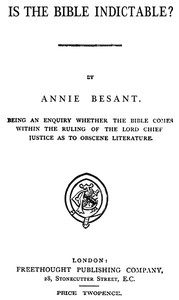
This careful 1911 survey, with its flat cataloguing of Nikah rites and polygamy limits, stirred a memory of my grandfather’s law books, untouched and smelling of dust. Another volume once gave me that same chill of detached order: Is the Bible Indictable? Being an Enquiry whether the Bible Comes within the Ruling of the Lord Chief Justice as to Obscene Literature — A Reader’s Guide posed its scandal quietly, asking only that I look, not judge. Both left me holding something heavy and strangely tender.
There are no reviews for this eBook.
There are no comments for this eBook.
Reader reflection
Take a moment to reflect on this book
Create a short personal record of your experience with this book.
Your progress
0
/
10
2
How much did you enjoy the reading experience?
3
How likely are you to recommend this book?
4
What was the reading difficulty like?
5
How closely did the book connect with your experience?
6
How would you describe its reading pace?
7
Could you apply anything you learned?
8
Did the book offer a fresh perspective?
9
What changed or sharpened your thinking?
10