1

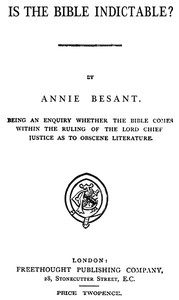
Is the Bible Indictable? Being an Enquiry whether the Bible Comes within the Ruling of the Lord Chief Justice as to Obscene Literature — A Reader’s Guide
(0 User reviews)
2019
Project Gutenberg
2011
Not confirmed
Bible -- Examinations, questions, etc.; Bible -- Miscellanea; Pornography -- Law and legislation
Readers of public-domain and historical texts
Project Gutenberg digital edition
en
Edition facts
Words
8,378
Reading time
37 min
Text sections
1
This digital edition of Is the Bible Indictable? Being an Enquiry whether the Bible Comes within the Ruling of the Lord Chief Justice as to Obscene Literature — A Reader’s Guide is described by source-level measurements including 8,378 words, 37 min estimated reading time, and 1 detected text section.
The text analysis averages about 20.4 words per sentence, while the detected sections provide another way to judge how the source is divided.
Project Gutenberg metadata also associates the work with “Bible -- Examinations, questions, etc.,” connecting these edition facts with the source record’s subject description.
Source:
Project Gutenberg record #38273
Annie Besant's 1877 pamphlet argues that the Bible contains obscene passages that would be indictable under the same legal standard used to prosecute her and Charles Bradlaugh for publishing a birth-control manual. She juxtaposes biblical verses with courtroom rulings, exposing class bias in obscenity law.
Read the complete public-domain text at its original source.
Read on Project GutenbergAnnie Besant opens this pamphlet by turning the logic of her own prosecution inside out. In 1877, she and Charles Bradlaugh were convicted for publishing a birth-control work; the Lord Chief Justice ruled that obscenity depended not on motive but on a text's potential to corrupt, regardless of price. Besant seizes that ruling and applies it to the Bible, asking why expensive medical books escape prosecution while cheap ones do not. She writes with forensic precision, quoting biblical passages alongside courtroom exchanges, and her tone shifts from cool legal analysis to withering sarcasm. The pamphlet is structured as a sequential indictment of Old Testament books, each judged by the same standard used against her.
The Price of Obscenity
Besant's central argument is economic. She notes that Dr. Fleetwood Churchill's expensive medical text, which gives detailed abortion instructions, is left unmolested, while Dr. Knowlton's cheap birth-control pamphlet is prosecuted. The obscenity, she writes, 'lies, to a great extent, in the price of the book sold.' A sixpenny book is obscene; a half-sovereign one is respectable. This class-based critique recurs throughout: the law protects wealthy seekers of knowledge while leaving the poor to ignorance or secret quackery. Besant does not merely complain—she documents the disparity with specific titles and prices, grounding her argument in the very trial transcript she cites.
Prophetic Coarseness Under Scrutiny
Besant moves through the prophets with a cataloguer's eye for offensive detail. She finds Ezekiel especially egregious, calling chapter 16 'obscene from beginning to end' and listing verses that describe sexual acts and bodily functions. She contrasts this with the prosecution's concern for young readers, noting that Ezekiel is placed in their hands. Her method is cumulative: she cites verse numbers without quoting them fully, trusting the reader to consult a Bible. The effect is a relentless inventory—Jeremiah, Hosea, Isaiah—each judged by the same standard. She reserves particular scorn for Hosea, whose marriage to a prostitute is commanded by God, then condemned by the prophet himself. 'Whether girls' morals are improved by the contemplation of such divine commands,' she asks, 'is a question that might fairly be urged.'
Sarcasm as Rhetorical Weapon
Besant's voice is most distinctive when she drops the legal mask and lets irony take over. Of Ezekiel eating the scroll, she remarks: 'it seems a pity that he did not eat a large part of his own, and so prevent it from poisoning other people.' She imagines the Lord Chief Justice committing Isaiah to a lunatic asylum for walking naked. These jabs are not mere flourishes; they serve to expose the absurdity of applying one standard to the Bible and another to secular works. The pamphlet's tone oscillates between dry legal reasoning and biting mockery, a strategy that keeps the reader engaged while reinforcing the argument that the Bible cannot be exempt from the law it is used to justify.
Besant never claims to have read every biblical book—she stops after Hosea, noting that Daniel 'may be left unnoticed.' This selective survey is deliberate: she needs only enough evidence to make her legal point. Readers should approach this pamphlet as a courtroom brief, not a theological treatise. Its power lies in its narrow focus: one legal ruling, one set of excerpts, one relentless question. The Bible, she concludes, is the most obscene book she knows—and if the law is consistent, it should be the first to be prosecuted.
Reading Besant’s pamphlet stayed with me—how she turns the law back on itself, quietly exposing its double standards. It made me think about rules we inherit without questioning, and I found a strange comfort in An Introduction to the Philosophy of Law — A Closer Reading, which lingers on the same human ache beneath statutes. Both left me staring at my own certainties.
There are no reviews for this eBook.
There are no comments for this eBook.
Reader reflection
What was your reading experience?
Capture what you thought, learned, and would like to remember.
Your progress
0
/
10
2
Was reading this book enjoyable?
3
Would you recommend this book to another reader?
4
What was the reading difficulty like?
5
How would you describe its reading pace?
6
Did any part of the book feel personally relevant?
7
How valuable was this book for your own interests?
8
How clearly were the main ideas presented?
9
What changed or sharpened your thinking?
10