1

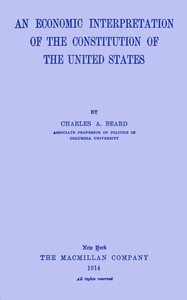
An economic interpretation of the Constitution of the United States — Reading Notes
(0 User reviews)
74
Project Gutenberg
2023
Not confirmed
Constitutional history -- United States; United States -- Economic conditions -- To 1865; United States. Constitution -- Economic aspects; Economic liberties (U.S. Constitution); Constitutional law -- Economic aspects -- United States
Readers of public-domain and historical texts
Project Gutenberg digital edition
en
Edition facts
Words
102,894
Reading time
448 min
Text sections
26
The source record for An economic interpretation of the Constitution of the United States — Reading Notes measures this digital text at 102,894 words, 7 hr 28 min estimated reading time, and 26 detected text sections.
The text analysis averages about 22.7 words per sentence, while the detected sections provide another way to judge how the source is divided.
Project Gutenberg metadata also associates the work with “Constitutional history -- United States,” connecting these edition facts with the source record’s subject description.
Source:
Project Gutenberg record #70677
Beard's 1913 study argues that the U.S. Constitution was shaped by economic interests, analyzing the financial holdings and political alignments of the Framers through Treasury records and convention debates.
Read the complete public-domain text at its original source.
Read on Project GutenbergCharles A. Beard’s An Economic Interpretation of the Constitution of the United States opens with a frank admission: the work is “fragmentary” and designed to “suggest new lines of historical research.” This self-conscious framing sets the tone for a study that prioritizes evidence over narrative. Beard draws heavily on Treasury Department records—used here for the first time in connection with the Constitution’s formation—and on the notes of convention delegates like James Madison and Rufus King. The result is a text that moves between dry financial data and sharp character sketches of the Framers, often within the same paragraph.
Voice and Self-Deprecation in the Preface
Beard’s preface establishes a distinctive scholarly voice: apologetic yet pointed. He writes that he cannot “give more than an occasional period to uninterrupted studies,” and therefore prints his findings “in the hope that a few of this generation of historical scholars may be encouraged to turn away from barren ‘political’ history.” The scare quotes around “political” signal his contempt for conventional approaches. This rhetorical move—confessing incompleteness while dismissing rival methods—recurs throughout the book. Beard’s tone is not neutral; it is combative, even when he claims humility. The preface also reveals his reliance on a network of archivists: he thanks Mr. Merwin of the Treasury Department and Mr. Fitzpatrick of the Manuscript Division for their patience. These acknowledgments ground his authority in institutional access, not just intellectual argument.
Pace Shifts Between Data and Portraiture
The excerpts show a marked alternation between two modes: dense citation of convention speeches and brisk biographical sketches. For instance, after quoting Oliver Ellsworth’s denunciation of “levelling democracy,” Beard immediately notes that Ellsworth “later as Chief Justice denounced from the bench Jefferson and the French party as ‘the apostles of anarchy, bloodshed, and atheism.’” This juxtaposition accelerates the pace—from a specific 1787 remark to a sweeping later career judgment. Similarly, Thomas Fitzsimons is dispatched in a single sentence: “a wealthy merchant and stockbroker… not a loquacious man, but rather a man of action—a practical man.” Beard then notes that Fitzsimons seconded a motion to restrict voting to freeholders “apparently without saying anything.” The brevity contrasts with the longer treatment of Elbridge Gerry, whose speech against popular election is quoted at length. These shifts in tempo create a rhythm: quick characterizations punctuate longer argumentative passages, keeping the reader alert.
Recurring Economic Language Across Debates
Beard’s analysis consistently foregrounds property and class. In the excerpts, delegates repeatedly use terms like “freeholders,” “owners of the soil,” and “the levelling spirit.” John Dickinson is quoted as saying, “we are safe by trusting the owners of the soil—the Owners of the Country.” Beard does not merely report these statements; he clusters them to show a pattern. The word “freeholders” appears multiple times, always in contexts defending property qualifications. Beard also notes that Benjamin Franklin “resisted the attempt to place property qualifications on the suffrage,” marking Franklin as an outlier. This repetition of economic vocabulary—along with Beard’s own terms like “stockbroker,” “wealthy merchant,” and “property basis”—creates a lexical field that reinforces his thesis. The reader is never allowed to forget that the Constitution’s framers spoke a language of economic interest, not abstract liberty.
Beard’s method rewards careful attention to his source citations and his strategic use of ellipses. The excerpts here are incomplete, but they reveal a writer who builds his case through accumulation: a delegate’s vote, a Treasury record, a quoted phrase. Readers should note how Beard selects and arranges evidence—his choices are as telling as the data itself. The book’s pace, alternating between brisk profiles and extended quotations, mirrors its argument: that individual economic interests, not philosophical consensus, drove the Constitution’s creation.
Reading Beard’s old Treasury tables, I kept thinking how every argument hides a pocketbook. There’s a sobering clarity in that, much like tracing the shifting rules around marriage and divorce—both are contracts we pretend are purely romantic. I found myself drifting to Marriage and Divorce Laws of the World — Edition Insights, remembering how law traces the shape of our wanting.
There are no reviews for this eBook.
There are no comments for this eBook.
Reader reflection
Your personal reading reflection
Build a private reading journal entry for this title.
Your progress
0
/
10
2
How much did you enjoy the reading experience?
3
Is this a title you would suggest to others?
4
What was the reading difficulty like?
5
Did it raise ideas you would like to talk about?
6
What did you appreciate most?
7
Would a second reading be valuable?
8
Did the story or argument move comfortably?
9
What did this book teach you most?
10