1

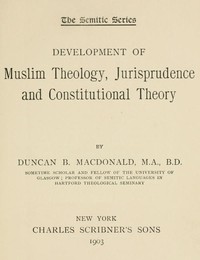
Development of Muslim Theology, Jurisprudence, and Constitutional Theory — Edition Insights
(0 User reviews)
75
Project Gutenberg
2019
Not confirmed
Islam -- Doctrines -- History; Islamic law -- History; Islam and state -- History; Constitutional law (Islamic law)
Readers of public-domain and historical texts
Project Gutenberg digital edition
en
Edition facts
Words
115,847
Reading time
504 min
Text sections
14
For Development of Muslim Theology, Jurisprudence, and Constitutional Theory — Edition Insights, the stored edition analysis reports 115,847 words, 8 hr 24 min estimated reading time, and 14 detected text sections.
The text analysis averages about 21.0 words per sentence, while the detected sections provide another way to judge how the source is divided.
Project Gutenberg metadata also associates the work with “Islam -- Doctrines -- History,” connecting these edition facts with the source record’s subject description.
Source:
Project Gutenberg record #59135
MacDonald traces the evolution of Islamic theology, jurisprudence, and constitutional theory through close analysis of primary sources, focusing on the interplay between rationalist and traditionalist schools, the development of legal methodology, and the political implications of theological disputes.
Read the complete public-domain text at its original source.
Read on Project GutenbergMacDonald opens his study by situating Islamic intellectual history within the broader Semitic tradition, but quickly narrows to the internal debates that shaped Muslim thought. The work moves chronologically from the early community through the classical schools, yet its organizing principle is not mere chronology but the dialectical tension between reason and revelation. Readers encounter the Mu'tazilites' rationalist theology, the Ash'arite synthesis, and the jurisprudential frameworks of the four Sunni schools, each presented through their own arguments and counter-arguments.
The excerpts reveal a recurring structural pattern: MacDonald presents a doctrinal position, then immediately introduces its critique from an opposing school, often using the same Qur'anic verses or hadith as proof texts. This dialogic method mirrors the actual debates he describes, making the text itself a performance of theological disputation.
The Architecture of Disputation
MacDonald structures his chapters around key controversies: the nature of God's attributes, free will versus predestination, the status of the Qur'an as created or uncreated, and the definition of faith. Each controversy is traced through multiple schools, with the author frequently pausing to note how a particular argument reappears in later thinkers. For instance, the Mu'tazilite insistence on God's unity leads to their denial of eternal attributes, a position that al-Ash'ari refines by distinguishing between essence and attributes. The reader is guided through these positions not as static doctrines but as moves in an ongoing argument.
The excerpts show MacDonald using a consistent expository device: he states a school's view, then immediately presents the counter-argument from a rival school, often quoting the same proof text to show how interpretation differs. This creates a sense of intellectual movement, as if the reader is watching a debate unfold. The structure thus mirrors the content: the development of theology is itself a series of disputations.
Recurring Images: Hands, Thrones, and Names
Certain images recur across the excerpts, particularly those drawn from anthropomorphic descriptions of God in the Qur'an. MacDonald notes that the literal meaning of the Qur'an assigns to God hands and feet, sitting on and descending from His throne. This image becomes a touchstone for debates about literalism versus allegory. The Mu'tazilites interpret such passages metaphorically to preserve divine transcendence; the Hanbalites accept them without asking how; and Ibn Hazm, writing later, resorts to lexicographical hunting to find alternative meanings for hand or foot.
Another recurring motif is the Ninety-nine Most Beautiful Names of God. Ibn Hazm argues that these names are limited to ninety-nine and cannot be extended by human reasoning, even if a name like al-Wahhab (the Bountiful Giver) seems praiseworthy. This image of a fixed list of names becomes a symbol of the tension between divine self-disclosure and human speculation. MacDonald uses these recurring images to show how the same textual features generate different theological responses.
Movement Between Schools and Regions
MacDonald traces the geographical movement of theological ideas from the eastern centers of Baghdad and Basra to the western reaches of Andalusia. The excerpts highlight Ibn Hazm, a Spanish theologian who, in MacDonald's account, deals more gently with the Mu'tazilites than with the Ash'arites, calling the former Muslims who sinned in ignorance and the latter unbelievers. This regional shift is accompanied by a shift in method: Ibn Hazm's approach is purely grammatical and lexicographical, in contrast to the speculative arguments of the Ash'arites.
The movement is not only geographical but also chronological. MacDonald notes that in Ibn Hazm's time there were but few Ash'arites in the West, and theology generally did not find many students. This observation underscores the uneven development of theological schools across the Islamic world. The reader is thus invited to see theology as a living, geographically dispersed conversation, not a monolithic tradition.
The Ethical Basis of Theology
MacDonald shows how theological positions have direct ethical consequences. Ibn Hazm, for example, makes his ethical basis the will of God only: God has willed that this should be a sin and that a good deed. Lying, Ibn Hazm concedes, is always saying what does not agree with the truth, but God may pronounce that one lie is a sin and one not. This radical voluntarism follows from his rejection of human qualities in God; since mercy in the human sense cannot be predicated of God, ethics must rest solely on divine command.
The excerpts also reveal how the debate over God's names affects ethical reasoning. If names like the Most Merciful are merely names, not descriptions of a quality, then human analogies for divine action are cut off. MacDonald presents this as a logical consequence of Ibn Hazm's system, but he also notes the startling implications: God tortures children with painful diseases, yet is called the Most Merciful. The ethical tension is left unresolved, reflecting the limits of the textual evidence available.
MacDonald's work is best approached as a guided tour of a debate, not a comprehensive history. Readers will benefit from attending to the way he juxtaposes sources and from noticing the recurring images that anchor abstract arguments. The excerpts suggest that the book rewards careful reading of its footnotes and citations, where the texture of the original debates is most visible. For those interested in the logic of theological argument, this study offers a model of how to present competing views without flattening their differences.
The rain kept me indoors with MacDonald’s careful mapping of law and belief, until his quiet insistence on justice in the early community lingered. Later, shelving it, I noticed The Law and the Poor — Text and Context, and the same concern surfaced, differently framed. One book’s theology became another’s daily wage, and the afternoon felt whole.
There are no reviews for this eBook.
There are no comments for this eBook.
Reader reflection
How did this book work for you?
Your answers remain private and are stored only in this browser.
Your progress
0
/
10
2
What was your overall reaction to the book?
3
How likely are you to recommend this book?
4
What was the reading difficulty like?
5
How did the pace of the book feel?
6
Did the book meet your expectations?
7
Could you apply anything you learned?
8
How strong was your personal connection to the text?
9
What is the main idea you are taking away?
10