1

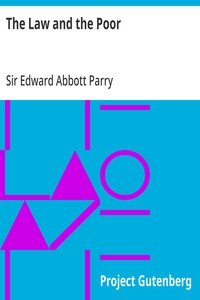
The Law and the Poor — Text and Context
(0 User reviews)
1396
Project Gutenberg
2011
Not confirmed
Law -- England; Poor laws -- England; Working class -- England; Poor -- England
Readers of public-domain and historical texts
Project Gutenberg digital edition
en
Edition facts
Words
91,419
Reading time
398 min
Text sections
10
The catalog record for The Law and the Poor — Text and Context provides practical reading context through 91,419 words, 6 hr 38 min estimated reading time, and 10 detected text sections.
The text analysis averages about 26.7 words per sentence, while the detected sections provide another way to judge how the source is divided.
Project Gutenberg metadata also associates the work with “Law -- England,” connecting these edition facts with the source record’s subject description.
Source:
Project Gutenberg record #36045
Judge Edward Abbott Parry's 1914 work examines how English law affects the poor, using case anecdotes and historical context to critique debt, compensation, and housing laws.
Read the complete public-domain text at its original source.
Read on Project GutenbergSir Edward Abbott Parry opens The Law and the Poor with a frank admission: this is not a law book, because law books are consulted, not read. Instead, he aims to dig material from the dirt heaps of legal procedure and present it in palatable form. The epigraph from Goldsmith—'Laws grind the poor and rich men rule the law'—sets the tone for a work that blends historical survey, judicial experience, and reformist argument.
Parry, a county court judge, writes from the bench. His introduction quotes Disraeli's 'Two Nations' and declares the law-and-poor a 'virgin subject.' The reader is warned that the book will not set out the whole law, but will focus on how legal machinery operates on those without means.
The Judge's Own Cases
Parry draws repeatedly on cases he presided over, giving the book an insider's authority. In one anecdote, a Manchester doorkeeper who bought an Airedale terrier to keep tally-men from his door is sued when the dog mauls a tout. Parry explains he had to find against the man 'as the law stands,' but the doorkeeper's question—'If you can’t ’ave a dorg, how can you keep them fellows out of the house?'—remains unanswered. The exchange reveals a gap between legal justice and common sense that Parry returns to throughout.
Another case involves a young servant who fled a good place after receiving a 'blue paper' threatening imprisonment over a missed instalment on a gold ring. Parry notes that the law need not assist the knave in making experience more expensive than necessary. These vignettes are not mere illustrations; they are the book's primary evidence.
Historical Roots of Present Hardship
The early chapters trace imprisonment for debt from ancient times through English history. Parry argues that the machinery of the law has long been stacked against the poor. He moves from the Ancients to the English debtor's prison, showing how legal forms persist long after their original rationale fades. The chapter 'How the Machine Works' describes the process by which a poor man can be caught in a web of costs and warrants.
Parry does not claim completeness; he selects episodes that illuminate a pattern. The historical sections serve to show that the problems he addresses are not new, but have been aggravated by complexity and indifference. The reader is given a sense of deep roots without being buried in detail.
Flat-Traps and the Married Woman
One chapter is titled 'Flat-Traps and Their Victims.' Parry defines flat-traps as legal devices that appear benign but ensnare the unwary. He discusses the Married Women's Property Act, which social reformers hailed, but which he says is often used fraudulently. Under the Workmen's Compensation Act, goods are alleged to be 'in the wife’s name' after an award against the husband, leaving the poor tradesman unable to test the claim in court.
Parry is careful not to blame the legislation itself, but its manipulation. He writes that many laws made for the best purposes are wrested from their beneficent uses by the wicked. The section is a warning that reform must consider not only the letter of the law but its practical enforcement.
The Two Public Houses
In a pair of chapters, Parry contrasts the alehouse and the workhouse as two public institutions that shape the lives of the poor. The alehouse is a place of escape and community; the workhouse is a place of discipline and stigma. He does not romanticize either, but shows how the law regulates both.
The workhouse, he argues, is a remedy that often punishes poverty rather than alleviating it. The alehouse, meanwhile, is subject to licensing laws that can be used to harass the poor. Parry's treatment is balanced: he acknowledges the need for order but questions whether the law's weight falls disproportionately. The chapter titles themselves—'The Two Public Houses'—underscore a structural view of poverty.
Parry's book is best read as a series of connected essays rather than a systematic treatise. The reader should attend to the anecdotes, which carry the argument more than the historical summaries. Parry writes as a reformer who knows the law from within, and his tone is that of a man who has seen too much to be optimistic but too engaged to be cynical. The final chapters on remedies—'Of To-day' and 'Of To-morrow'—offer proposals, but the book's lasting value lies in its concrete depiction of how law feels to those it governs.
That rainy afternoon, The Law and the Poor left me with the quiet ache of how the system speaks over the vulnerable. I set it down, restless, and my hand drifted to the shelf—landing on A brief summary in plain language of the most important laws concerning women — Text and Context. Same century’s blind spot, different voice missing from the room. It felt like turning the page sideways.
There are no reviews for this eBook.
There are no comments for this eBook.
Reader reflection
Take a moment to reflect on this book
Create a short personal record of your experience with this book.
Your progress
0
/
10
2
How did the book work for you overall?
3
Would you pass this book on to a friend?
4
Did the language feel accessible?
5
Did the story or argument move comfortably?
6
Would a second reading be valuable?
7
What was its emotional impact?
8
How useful were the ideas in this book?
9
What changed or sharpened your thinking?
10