1

A brief summary in plain language of the most important laws concerning women — Text and Context
(0 User reviews)
892
Project Gutenberg
2025
Not confirmed
Women -- Legal status, laws, etc. -- Great Britain
Readers of public-domain and historical texts
Project Gutenberg digital edition
en
Edition facts
Words
9,150
Reading time
40 min
Text sections
4
The catalog record for A brief summary in plain language of the most important laws concerning women — Text and Context provides practical reading context through 9,150 words, 40 min estimated reading time, and 4 detected text sections.
The text analysis averages about 24.0 words per sentence, while the detected sections provide another way to judge how the source is divided.
Project Gutenberg metadata also associates the work with “Women -- Legal status, laws, etc. -- Great Britain,” connecting these edition facts with the source record’s subject description.
Source:
Project Gutenberg record #77027
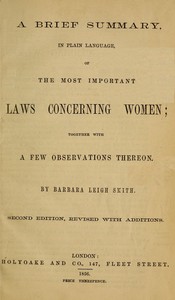
Barbara Bodichon's 1856 pamphlet concisely details English laws on women's property, marriage, and employment, contrasting them with French, Turkish, and Hungarian codes. The plain-language exposition reveals stark legal inequalities, particularly the married woman's loss of property rights and the single woman's limited franchise.
Read the complete public-domain text at its original source.
Read on Project GutenbergBarbara Bodichon opens her 1856 pamphlet with a striking asymmetry: a single woman, she notes, has the same property rights and tax obligations as a man, yet cannot vote in parliamentary elections. This precise legal contradiction sets the tone for a work that methodically catalogs the disabilities imposed on women by English law. The author's choice of plain language is itself a rhetorical strategy—by stripping away legal jargon, she exposes the bare inequities of coverture, inheritance rules, and employment restrictions. The pamphlet's structure moves from the unmarried woman's qualified independence to the married woman's near-total legal submergence, then widens to comparative law, implicitly asking why English marriage extinguishes a woman's legal personality while French, Turkish, and Hungarian systems preserve it.
The Unmarried Woman's Conditional Autonomy
Bodichon begins with the spinster, whose legal standing is deceptively close to a man's. She can own property, pay taxes, and sue—but the pamphlet immediately undercuts this parity: “No political franchise.” The single woman of age cannot vote for Parliament, though she may vote on parish questions. The author's diction here is deliberately flat, letting the anomaly speak for itself. She then turns to inheritance, where the law prefers males: an eldest brother inherits real property over sisters, even his own daughters. The phrase “males and their issue being preferred to females” encapsulates a systemic bias that Bodichon does not editorialize but merely records. Employment is similarly circumscribed: “The church and nearly all offices under government are closed to women.” The Post Office offers “some little employment,” but no important office—except sovereign. That single exception, delivered without emphasis, underscores the absurdity of a system that permits a queen but not a female voter or lawyer.
Coverture: The Married Woman's Legal Death
The married woman, Bodichon explains, is legally absorbed into her husband. Her property becomes his; she cannot contract, sue, or make a will without his consent. The pamphlet's phrasing is clinical: “A married woman has no legal existence separate from her husband.” This is the doctrine of coverture, and Bodichon lets its consequences accumulate. She notes that a wife cannot keep her own earnings, cannot bequeath property, and cannot claim damages for injury—her husband must do so. The author's choice to list these disabilities in parallel clauses creates a rhythm of erasure. She then poses a direct question: “Why does marriage make so little legal difference to men, and such a mighty legal difference to women?” The question is not answered in the excerpts, but its placement after the catalogue of loss invites the reader to supply the answer: the law is designed to maintain male dominion. Bodichon's restraint—refusing to moralize—makes the indictment more powerful.
Comparative Legal Systems as Implicit Critique
Bodichon turns to France, Turkey, and Hungary, offering alternatives that highlight English exceptionalism. In France, the régime de communauté allows a wife to retain ownership of immoveable property, though the husband administers it. She can even obtain a séparation des biens if he mismanages the common fund. Turkey, Bodichon notes, grants daughters equal inheritance in houses and land, and a widow receives one-eighth of personal property with lifelong support. Hungary's pre-1849 law gave a widow guardianship of children and, remarkably, “all the political rights of a man” while she bore her husband's name. These details are not presented as utopian—Bodichon notes that Hungarian single women were considered minors—but they demonstrate that legal subordination of married women is not inevitable. The comparative section functions as a quiet rebuttal to those who would claim English law reflects natural order. By citing the Law Amendment Society's report on France, she grounds her argument in reformist discourse.
The Rhetoric of Plainness and Precision
Bodichon's title promises “plain language,” and she delivers it through short declarative sentences, numbered lists, and repeated syntactic structures. She avoids metaphor and emotional appeal, relying instead on the weight of accumulated fact. For example, the section on domestic servants notes that a verbal agreement binds both parties—a rare moment of legal symmetry. The seduction clause is devastating in its brevity: “If a woman is seduced, she has no remedy against the seducer.” The father may sue only if he can claim loss of his daughter's services as a servant. This legal fiction reduces a woman's injury to an economic loss suffered by her male guardian. Bodichon's choice to include such details without commentary forces the reader to recognize the law's cruelty. Her use of footnotes (indicated by bracketed numbers) signals scholarly care, while the pamphlet's low price—threepence—suggests an intended audience of working women and reformers. The second edition's revisions imply ongoing engagement with legal change.
Bodichon's pamphlet is best read as a legal brief for reform, not a neutral digest. Its power lies in what it omits: no calls to action, no emotional pleas, only the stark architecture of the law. Readers should attend to the gaps between what the law says and what it permits—the single woman who can vote for a parish clerk but not for Parliament, the married woman who cannot keep her own wages. The comparative sections are not digressions but evidence that alternative arrangements exist. Bodichon's plainness is a weapon; she trusts the facts to do their work.
Reading Bodichon’s pamphlet, I kept thinking how quietly we inherit the laws we live under, hardly noticing their weight until someone writes them down plainly. It made me nostalgic for a time when legal change felt possible just by explaining things clearly. That same careful patience for unseen structures lingers somewhere in International Law. A Treatise. Volume 2 (of 2) War and Neutrality. Second Edition — Inside the Classic, another old friend whose pages seem to hold the same wistful certainty.
There are no reviews for this eBook.
There are no comments for this eBook.
Reader reflection
Your personal reading reflection
Build a private reading journal entry for this title.
Your progress
0
/
10
2
What was your overall reaction to the book?
3
How likely are you to recommend this book?
4
How demanding did the text feel?
5
How well did it match your expectations?
6
How personally connected did you feel to the book?
7
Which aspect of the book did you value most?
8
How useful did the reading feel?
9
What changed or sharpened your thinking?
10