1

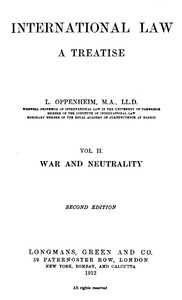
International Law. A Treatise. Volume 2 (of 2) War and Neutrality. Second Edition — Inside the Classic
(0 User reviews)
933
Project Gutenberg
2012
Not confirmed
International law
Readers of public-domain and historical texts
Project Gutenberg digital edition
en
Edition facts
Words
266,132
Reading time
1158 min
Text sections
52
The catalog record for International Law. A Treatise. Volume 2 (of 2) War and Neutrality. Second Edition — Inside the Classic provides practical reading context through 266,132 words, 19 hr 18 min estimated reading time, and 52 detected text sections.
The text analysis averages about 22.5 words per sentence, while the detected sections provide another way to judge how the source is divided.
Project Gutenberg metadata also associates the work with “International law,” connecting these edition facts with the source record’s subject description.
Source:
Project Gutenberg record #41047
Oppenheim's second edition (1912) of his treatise on war and neutrality, revised with new sections on Hague Conventions and the Declaration of London, examines asylum on neutral territory through historical examples and legal reasoning.
Read the complete public-domain text at its original source.
Read on Project GutenbergOppenheim's second edition of International Law. Volume II: War and Neutrality (1912) opens with a preface noting that the text has been increased by one hundred pages, largely due to the inclusion of the thirteen Conventions of the Second Hague Peace Conference and the Declaration of London. The author acknowledges the difficulty of writing a comprehensive treatise when these instruments have not yet been ratified, yet he proceeds to expound them as if they were settled law. This tension between codification and custom runs through the work.
The Author's Method: Revision and Expansion
Oppenheim states that the system of the work remains the same, but portions on Enemy Character, Commencement of War, and Unneutral Service have been entirely rewritten, with new section headings. He adds a whole chapter on the proposed International Prize Court. The preface makes clear that this is not a mere reprint: the author has engaged with recent state practice and scholarly debate. For instance, he discusses whether enemy subjects have persona standi in judicio (§ 100a) and whether trading with enemy subjects is permitted (§ 101). These additions reflect the evolving nature of the law in the early twentieth century.
Asylum on Neutral Territory: A Case-Driven Analysis
In the section on neutral territory as an asylum, Oppenheim grounds his legal principles in concrete historical incidents. He cites the 1558 case of Turkish and Barbary captives who escaped from a Spanish galley wrecked near Calais; France considered them freed by reaching her territory and sent them to Constantinople, despite the Spanish Ambassador's claim. He also references the Franco-German War of 1870, when Belgium detained a French non-commissioned officer who had escaped from German captivity onto Belgian soil. These examples show how Oppenheim uses state practice to illustrate and test legal rules.
The Duty of Impartiality and Territorial Supremacy
Oppenheim emphasizes that a neutral's duty of impartiality does not require refusing asylum to enemy persons or property; rather, the neutral must prevent its territory from being used as a base of hostile operations. He distinguishes between different categories of asylum: for private enemy property, public war material, private subjects, land forces, and naval forces. The discussion is structured around these categories, with cross-references to later sections on naval forces (§§ 342-348). The author's prose is precise, often using conditional clauses to delineate the limits of legal obligations.
Prisoners of War and the Principle of Liberty
A key principle stated is that prisoners of war regain their liberty ipso facto by coming into neutral territory, regardless of how they arrive—whether by escape or by being brought there by enemy troops. Oppenheim notes that this principle has been 'generally recognised for centuries,' but he then raises a nuanced question: does the neutral have a duty to detain such fugitives to prevent them from rejoining the enemy army? He reports that in 1870 Belgium answered in the affirmative, but he does not assert that this is settled law. The careful phrasing leaves room for debate, reflecting the treatise's role as a scholarly exposition rather than a code.
Oppenheim's treatise rewards readers who attend to his use of historical examples and his careful qualification of legal rules. The second edition captures a moment when international law was being reshaped by multilateral conventions, yet customary practice still supplied the essential content. Readers should note the author's habit of stating a general principle and then immediately testing it against state practice or hypothetical cases, a method that makes the work both rigorous and engaging.
Reading Oppenheim’s careful pages on neutral territory, with their patient weighing of precedent and mercy, reminded me of an old, gentler argument I once found in The New Sunday Liquor Law Vindicated — Inside the Classic. Both books ask quietly how law bends around human need, granting shelter or a glass on a solemn day. Strange, how such different rules can share one soft, considered tone.
There are no reviews for this eBook.
There are no comments for this eBook.
Reader reflection
How did this book work for you?
Your answers remain private and are stored only in this browser.
Your progress
0
/
10
2
Was reading this book enjoyable?
3
Would you recommend this book to another reader?
4
How demanding did the text feel?
5
Could you apply anything you learned?
6
How closely did the book connect with your experience?
7
Was the book moving at the right speed?
8
Which aspect of the book did you value most?
9
What did this book teach you most?
10