1

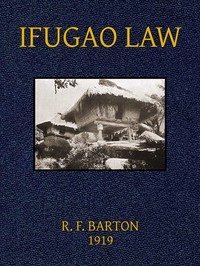
Ifugao Law (In American Archaeology and Ethnology, Vol. 15, No. 1) — Background and Themes
(0 User reviews)
3683
Project Gutenberg
2012
Not confirmed
Ethnology -- Philippines; Ifugao (Philippine people); Law, Primitive -- Philippines
Readers of public-domain and historical texts
Project Gutenberg digital edition
en
Edition facts
Words
60,232
Reading time
262 min
Text sections
23
For Ifugao Law (In American Archaeology and Ethnology, Vol. 15, No. 1) — Background and Themes, the stored edition analysis reports 60,232 words, 4 hr 22 min estimated reading time, and 23 detected text sections.
The text analysis averages about 17.1 words per sentence, while the detected sections provide another way to judge how the source is divided.
Project Gutenberg metadata also associates the work with “Ethnology -- Philippines,” connecting these edition facts with the source record’s subject description.
Source:
Project Gutenberg record #40807
An ethnographic analysis of Ifugao customary law, examining marriage, property, and adultery through case studies and native terminology, based on early 20th-century fieldwork.
Read the complete public-domain text at its original source.
Read on Project GutenbergBarton opens with a pointed epigraph from R. R. Marrett, challenging the view of "the savage as a freakish creature" and arguing that a healthy primitive society is more law-abiding than a civilized one. This framing sets the tone for a work that treats Ifugao legal customs not as curiosities but as a coherent system deserving serious study. The text is dense with native terms—hokwit, luktap, binawit, mommon—and uses case narratives, such as the story of Maxima and Ananayo, to illustrate legal principles. Barton’s authorial choices reveal a commitment to precision: he distinguishes degrees of adultery by specific Ifugao ceremonies and diagrams fines "Ifugao fashion." The result is a meticulous record of a legal order that operates through fines, kin obligations, and public opinion rather than centralized enforcement.
Diction and Native Categories
Barton’s diction is deliberately technical, borrowing Ifugao terms to mark legal categories that English lacks. He does not simply translate hokwit as "aggravated adultery" but defines it through behavior: "openly and scandalously bestowing one’s love and body upon some other person than the spouse." The term luktap covers simple adultery, while hokwit carries the intent to separate. This lexical precision extends to property: the Ifugao classification of properties (section 32) is given in the original, with terms like paghok for landmarks. Barton’s choice to retain native words forces the reader to engage with Ifugao conceptual frameworks rather than imposing Western legal categories. The effect is ethnographic rather than comparative; he is documenting a system on its own terms.
Voice and the Ethnographer’s Stance
Barton’s voice is that of a detached observer who nonetheless makes evaluative judgments. He notes that a wife is "more likely to forgive" adultery than a husband, and that public opinion backs a husband who kills an adulterer caught in delicto. Yet he also records that the kin of the killed often avenge the death, taking the view that a fine should have been demanded. This tension—between describing norms and noting exceptions—reveals Barton’s awareness that Ifugao law is not monolithic. His prose is declarative and unadorned: "Adultery being a very hard crime to prove, the Ifugao takes as proof: (1) the confession of either party; (2) evidence that the accused wilfully and intentionally placed themselves in such a position." The simplicity of the syntax mirrors the clarity he seeks to impose on a complex social field.
Structure: From General Principles to Case Law
The book’s structure moves from broad principles to specific applications. Early sections address "Relation of taboo to law" and "Scope of customary law," establishing a framework. Later sections on marriage, divorce, and adultery are organized by numbered paragraphs (e.g., sections 94–95 on adultery). Each legal point is illustrated with a case: the story of Maxima and Ananayo exemplifies hokwit, while the discussion of punishment includes stories of impalement. This alternation between rule and example mirrors common-law reasoning. Barton also uses diagrams (referenced in section 75) to map fines by ceremony, showing a visual logic. The structure thus enacts the very system it describes: a body of customary law that is both abstract and grounded in precedent.
Recurring Details: Fines, Kin, and Public Opinion
Three motifs recur throughout the excerpts: fines calibrated by ceremony, the role of kin in punishment and vengeance, and the weight of public opinion. Adultery fines increase with the solemnity of the mommon, imbango, and bubun ceremonies. The pu-u of the fine goes to the offended spouse, the rest to kin—a detail that underscores the collective nature of Ifugao law. Public opinion is invoked repeatedly: the offended spouse is "justified by public opinion" in killing an adulterer, yet kin may avenge the killing because they feel a fine should have been taken. These details build a picture of a legal system where social consensus, not a state, enforces norms. Barton’s attention to such nuances makes the work a valuable record of a non-state legal order.
Readers should approach this text as a primary source in legal anthropology, not a narrative. Barton’s reliance on native terminology and case studies means that the book rewards careful attention to the Ifugao words and the logic of fines. The work is best read alongside an awareness of its early 20th-century context: Barton writes as an ethnographer for an academic audience, but his commitment to documenting a living legal system gives the text enduring value for those interested in customary law, kinship, and the sociology of punishment.
I keep thinking about how the Ifugao book frames law not as rules but as relationships—property and marriage woven into everyday speech. It reminded me of something quieter, older, a similar patience with custom and consequence. Have you ever felt that? Hindu Law and Judicature from the Dharma-Sástra of Yájnavalkya — Inside the Classic carries that same unhurried weight, like hearing a familiar story told in a dialect you almost remember.
There are no reviews for this eBook.
There are no comments for this eBook.
Reader reflection
Record your reading impressions
A brief reflection can help important ideas stay with you longer.
Your progress
0
/
10
2
What was your overall reaction to the book?
3
How likely are you to recommend this book?
4
How easy was the book to follow?
5
How original did the book feel?
6
Which part made the strongest impression?
7
How closely did the book connect with your experience?
8
How useful did the reading feel?
9
Which lesson or insight stayed with you?
10