1

Lectures on the constitution and laws of England With a commentary on Magna Charta, and illustrations of many of the English statutes — Text and Context
(0 User reviews)
373
Project Gutenberg
2022
Not confirmed
Magna Carta -- Early works to 1800; Constitutional history -- England -- Early works to 1800; Feudal law -- England -- Early works to 1800
Readers of public-domain and historical texts
Project Gutenberg digital edition
en
Edition facts
Words
176,095
Reading time
766 min
Text sections
53
For Lectures on the constitution and laws of England With a commentary on Magna Charta, and illustrations of many of the English statutes — Text and Context, the stored edition analysis reports 176,095 words, 12 hr 46 min estimated reading time, and 53 detected text sections.
The text analysis averages about 34.7 words per sentence, while the detected sections provide another way to judge how the source is divided.
Project Gutenberg metadata also associates the work with “Magna Carta -- Early works to 1800,” connecting these edition facts with the source record’s subject description.
Source:
Project Gutenberg record #69351
An 18th-century legal commentary on Magna Carta and English statutes, delivered as university lectures. The excerpts show detailed analysis of feudal knighthood, its evolution from military service to a revenue tool, and the constitutional tensions it created.
Read the complete public-domain text at its original source.
Read on Project GutenbergFrancis Stoughton Sullivan's Lectures on the Constitution and Laws of England, published posthumously in a second edition with a prefatory discourse by Gilbert Stuart, offers a detailed examination of English legal history through the lens of feudal law and Magna Carta. The excerpts reveal a work grounded in the specifics of medieval institutions, such as the creation of knights banneret and the changing nature of knighthood, rather than broad constitutional theory. Sullivan traces how a military obligation—personal service in the field—gradually became a means for the crown to raise revenue, culminating in the grievances that led to the repeal of Edward II's statute in the seventeenth year of Charles I's reign.
Feudal Tenure and the Transformation of Knighthood
The excerpts devote considerable attention to the institution of knighthood as a feudal obligation. Sullivan explains that originally, every holder of a whole knight's fee was required to serve in person, and the king could summon individuals to prove their qualifications and receive the order. Over time, this duty was commuted into a payment—escuage—and eventually became a "profitable fruit of the king's seignory," used to extract money from those unwilling or unable to serve. The act of Edward II fixed the qualifying estate at twenty pounds a year, but Sullivan notes that by Charles I's reign, the real value of money had changed so drastically that summoning those with forty pounds a year was still an "unsupportable grievance." This analysis is grounded in specific monetary comparisons: a pound in Edward's reign was a real pound of silver, whereas in Charles's it was only a third of that weight.
The Crown's Prerogative and Parliamentary Conflict
Sullivan's discussion of knighthood directly ties to the constitutional struggles between crown and parliament. He describes how Charles I used the power of summoning knights as an expedient to raise money when he "quarrelled with his parliament," a phrase that points to the fiscal disputes preceding the English Civil War. The author calculates that, accounting for both the debasement of coinage and the increase in land values due to commerce, Charles should have set the threshold at one hundred and twenty pounds rather than forty. The repeal of Edward II's statute in the seventeenth year of Charles's reign is presented as a direct consequence of this overreach. Sullivan's method—combining legal history with economic reasoning—illustrates how the lectures aimed to show the practical effects of legal rules on governance.
Gilbert Stuart's Editorial Role and the Work's Context
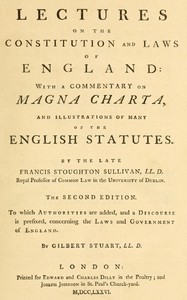
The title page and prefatory material reveal that this edition was prepared by Gilbert Stuart, who added authorities and a discourse on the laws and government of England. Stuart's dedication to Lord North, then First Lord of the Treasury, frames the work as a defense of the constitution "at a most critical period," likely the American Revolutionary era. The advertisement notes that Sullivan's lectures "procured a very high Reputation" at the University of Dublin and were published to "illustrate his Memory." This paratextual evidence suggests the work was valued both as a scholarly contribution and as a timely commentary on constitutional principles. Readers should note that the excerpts focus on feudal details rather than Magna Carta directly, and the full text likely contains the promised commentary on that charter.
The excerpts from Sullivan's lectures demonstrate a methodical approach to legal history, using precise monetary and procedural details to explain how feudal institutions evolved and sparked constitutional conflict. Readers interested in the development of English law will find a work that grounds abstract principles in concrete practices, from the dubbing of knights to the repeal of statutes. The presence of Gilbert Stuart's supplementary discourse adds an eighteenth-century editorial perspective that situates the lectures within the political debates of their own time.
That rainy afternoon, I lost myself in Lectures on the Constitution, tracing how a feudal obligation slowly hardened into a tax the crown could wield. The dry statutes felt alive, almost breathing. Later, flipping through unrelated notes, I stumbled upon The Legal Position of the Clergy — Background and Themes, and the same quiet tension echoed there—privilege, duty, and the slow drift from service to leverage.
There are no reviews for this eBook.
There are no comments for this eBook.
Reader reflection
What did you think of this book?
Answer a few questions and save a private reflection on this device.
Your progress
0
/
10
2
How did the book work for you overall?
3
Is this a title you would suggest to others?
4
How easy was the book to follow?
5
How strong was your personal connection to the text?
6
Which element worked best for you?
7
How useful were the ideas in this book?
8
How strongly did the book affect you emotionally?
9
What is the main idea you are taking away?
10