1

Legal antiquities — Reading Companion
(0 User reviews)
2748
Project Gutenberg
2025
Not confirmed
Law -- History; Law, Ancient; Criminal law -- History; Punishment -- History
Readers of public-domain and historical texts
Project Gutenberg digital edition
en
Edition facts
Words
103,816
Reading time
452 min
Text sections
26
For Legal antiquities — Reading Companion, the stored edition analysis reports 103,816 words, 7 hr 32 min estimated reading time, and 26 detected text sections.
The text analysis averages about 22.1 words per sentence, while the detected sections provide another way to judge how the source is divided.
Project Gutenberg metadata also associates the work with “Law -- History,” connecting these edition facts with the source record’s subject description.
Source:
Project Gutenberg record #75835
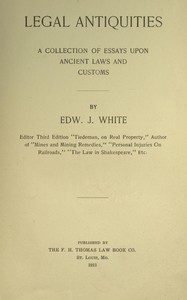
Edward J. White's 1913 collection examines ancient laws and customs through eleven essays, including marriage, witchcraft, trial by battle, and punishments. The excerpts reveal a moralizing tone and detailed case studies, such as Margaret Clitherow's pressing death, illustrating the gap between catalog subjects and the author's rhetorical approach.
Read the complete public-domain text at its original source.
Read on Project GutenbergEdward J. White opens his 1913 collection by lamenting that the commercial spirit of the age leaves citizens too engrossed to study institutional history. This framing, from the introduction, sets a moralizing tone that pervades the essays. The catalog subjects—law history, ancient law, criminal law, punishment—suggest a dry survey, but the excerpts show White weaving dramatic narratives, such as the pressing of Margaret Clitherow, with explicit commentary on 'man's inhumanity to man.' The work is less a neutral account than a cautionary plea against discarding the lessons of the past.
A Moralizing Frame, Not a Dry Survey
The introduction positions the book as a corrective to an age of 'fast and furious pace' and disrespect for institutions. White argues that studying past brutalities should make readers 'slow to return to the customs or remedies which a past civilization found unavailing.' This is not a dispassionate legal history; it is a rhetorical project. The catalog subjects list 'Law -- History' and 'Punishment -- History,' but White’s own words reveal a writer more interested in drawing moral lessons than in systematic analysis. He warns that 'even a burnt child will avoid the fire,' a homily that signals his preference for vivid example over abstract doctrine.
Case Studies as Emotional Set Pieces
The excerpt on peine forte et dure centers on Margaret Clitherow, pressed to death in 1586 for harboring Catholic priests. White narrates her story with novelistic detail: her refusal to plead, the entreaties of Parson Whigington, the jeering crowd, and the sheriff’s eagerness. He describes her as 'courting martyrdom' and frames her death as a deliberate demonstration against 'hideous punishment.' The account includes direct speech—'by God and your consciences'—and sensory details like her bare feet and the door laid upon her body. This is not a legal analysis of the peine forte et dure procedure; it is a moral drama, complete with a villainous sheriff named Fawcett and a sympathetic priest. The catalog subject 'Criminal law -- History' barely captures this emotional, almost hagiographic treatment.
Structure and Voice: Essays, Not a Monograph
The table of contents lists eleven chapters, each on a distinct topic: marriage laws, witchcraft, trial by battle, ordeal, benefit of clergy, sanctuary, ancient punishments, and wills. This structure, typical of a collection of essays, means the book does not build a single argument but offers a series of standalone studies. White’s voice is consistent: he is a lawyer and editor (of Tiedeman on Real Property) who writes for a general audience, using archaic phrases like 'quaint and curious' for wills. The excerpts show he favors narrative over doctrine, and his asides—such as calling the sheriff 'the inhuman wretch'—reveal a partisan stance. The catalog subjects imply a comprehensive history, but the book is selective, focusing on the most sensational or 'antiquated' practices.
Readers should approach Legal Antiquities as a series of moral essays rather than a systematic legal history. White’s evident sympathy for figures like Margaret Clitherow and his disdain for 'barbarous' punishments shape every chapter. The book is best read for its vivid case studies and period flavor, not for balanced analysis. Those seeking a dry account of legal evolution will find instead a work that wears its heart on its sleeve.
That rainy afternoon, Legal Antiquities — Reading Companion kept me indoors, its account of Margaret Clitherow’s pressing lingering long after I set it down. The weight of law upon ordinary lives felt almost unbearable, so I drifted to a quieter shelf. White’s moralizing softened into something steadier there, in The Legal Position of the Clergy — Background and Themes, where ancient rules met a gentler, everyday piety. One book simply handed me the next.
There are no reviews for this eBook.
There are no comments for this eBook.
Reader reflection
How did this book work for you?
Your answers remain private and are stored only in this browser.
Your progress
0
/
10
2
Was reading this book enjoyable?
3
Would you recommend this book to another reader?
4
How easy was the book to follow?
5
Do you expect to return to this book?
6
How strongly did the book affect you emotionally?
7
Did the book give you something worth debating?
8
What did you appreciate most?
9
What is the main idea you are taking away?
10