1

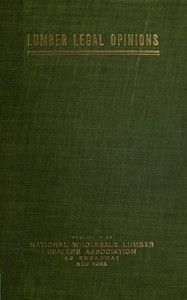
Lumber Legal Opinions — Background and Themes
(0 User reviews)
1342
Project Gutenberg
2019
Not confirmed
Lumber trade -- United States -- Cases; Legal opinions -- United States -- Cases
Readers of public-domain and historical texts
Project Gutenberg digital edition
en
Edition facts
Words
39,785
Reading time
173 min
Text sections
101
This digital edition of Lumber Legal Opinions — Background and Themes is described by source-level measurements including 39,785 words, 2 hr 53 min estimated reading time, and 101 detected text sections.
The text analysis averages about 28.0 words per sentence, while the detected sections provide another way to judge how the source is divided.
Project Gutenberg metadata also associates the work with “Lumber trade -- United States -- Cases,” connecting these edition facts with the source record’s subject description.
Source:
Project Gutenberg record #60134
A 1910 compilation of legal opinions for lumber dealers, covering contract disputes, payment, protest, and F.O.B. shipments. Based on actual member cases, it offers practical guidance on trade customs and common law principles.
Read the complete public-domain text at its original source.
Read on Project GutenbergThis 1910 volume collects legal opinions prepared by the National Wholesale Lumber Dealers Association for its members. The preface frames the work as “based upon the practical working out of specific cases,” aiming to express “good common sense, and consequently good law.” The opinions address recurring commercial questions—such as whether a creditor can keep a partial payment tendered “as payment in full” and still sue for the balance—and illustrate how trade customs intersect with common law rules. The compilers emphasize that the guidance is general, noting that state court decisions may affect particular outcomes.
The Tender Trap: Partial Payment and Accord
Opinion No. 51 dissects a classic debtor-creditor dilemma: when a debtor sends a check marked “payment in full” for less than the claimed amount, what are the creditor’s options? The opinion states that if the amount is “liquidated and certain,” the creditor cannot discharge the whole debt by accepting part. But if the amount is disputed in good faith, the debtor may tender a reasonable sum as his estimate; the creditor who accepts the tender “cannot accept the tender without accepting the estimate.” The creditor must return the money to preserve the right to sue for more. The reasoning turns on fairness: it would be “unfair” to let the creditor keep the payment and still litigate for a higher sum. This opinion exemplifies the volume’s practical bent—it gives a clear rule for a situation that likely arose often in the lumber trade.
Protest and Primary Liability
Opinion No. 52 addresses whether protest is necessary to hold the maker of a note or the acceptor of a draft liable. The answer is a firm no: “protest and notice are not necessary to charge the maker of a promissory note or the acceptor of a bill of exchange.” The reasoning is that the object of protest is to inform parties “secondarily liable” that the primary party has refused payment. Since the primary party already knows demand was made and refused, formal notice would be redundant. The opinion calls this “the sound rule in all cases.” This succinct ruling reflects the volume’s focus on stripping away unnecessary formalities in commercial transactions.
F.O.B. Shipments and Risk of Loss
Opinion No. 52 (or a related opinion) tackles the question of who bears risk when a shipper sells goods at a price including freight to destination but issues the bill of lading in the buyer’s name. The opinion explains that title passes on delivery to the carrier unless the contract says otherwise or the seller reserves title. A mere agreement to pay freight does not rebut the presumption that title passes at shipment. However, if goods are sold “f. o. b. destination,” the seller must deliver at that place and bears the risk until tender. The key distinction: an obligation to deliver at destination inherently includes paying freight; a separate freight agreement does not impose delivery risk. This opinion clarifies a common point of confusion in lumber contracts.
Readers should treat each opinion as a snapshot of early twentieth-century commercial law, not as current legal advice. The volume is best approached as a primary source on trade practices and legal reasoning in the wholesale lumber industry. The opinions are concise and often cite no authority beyond common sense, making them accessible to non-lawyers. For those studying the history of contract law or the lumber trade, this collection offers a window into the everyday legal problems of the era.
Holding that lumber dealer’s handbook, I thought of my grandfather’s ledger—dry columns of board feet and payments, yet each line a quiet argument about honor. Then my mind drifted to Speech of John Hossack, Convicted of a Violation of the Fugitive Slave Law Before Judge Drummond, Of The United States District Court, Chicago, Ill. — Story, Setting & Ideas. Both texts feel like stone markers—one for trade customs, one for a moral line—left for strangers to read slowly, wondering what we owe each other.
There are no reviews for this eBook.
There are no comments for this eBook.
Reader reflection
Your personal reading reflection
Build a private reading journal entry for this title.
Your progress
0
/
10
2
Did this book hold your interest?
3
Is this a title you would suggest to others?
4
How easy was the book to follow?
5
Did the book give you something worth debating?
6
Was the book easy to understand?
7
How distinctive were its ideas or approach?
8
What was the strongest part of the book?
9
Which lesson or insight stayed with you?
10