1

Medical Jurisprudence, Forensic medicine and Toxicology. Vol. 1 — Reading Notes
(0 User reviews)
477
Project Gutenberg
2015
Not confirmed
Medical jurisprudence; Poisons; Toxicology
Readers of public-domain and historical texts
Project Gutenberg digital edition
en
Edition facts
Words
315,520
Reading time
1372 min
Text sections
42
The catalog record for Medical Jurisprudence, Forensic medicine and Toxicology. Vol. 1 — Reading Notes provides practical reading context through 315,520 words, 22 hr 52 min estimated reading time, and 42 detected text sections.
The text analysis averages about 21.1 words per sentence, while the detected sections provide another way to judge how the source is divided.
Project Gutenberg metadata also associates the work with “Medical jurisprudence,” connecting these edition facts with the source record’s subject description.
Source:
Project Gutenberg record #49027
This 1894 reference work systematically organizes medical jurisprudence, forensic medicine, and toxicology into distinct sections, with detailed chapters on wounds, autopsies, and time-of-death determination, drawing on legal cases and expert collaboration.
Read the complete public-domain text at its original source.
Read on Project GutenbergThe volume opens by distinguishing the surgical and medico-legal definitions of a wound, noting that the latter includes contusions, fractures, burns, and even voluntary inoculation of syphilis. This taxonomic precision recurs throughout: the authors consistently separate legal from clinical categories, as when they define death by submersion or starvation as distinct medico-legal entities. The work’s structure mirrors this analytical approach, dividing into three main parts—Medical Jurisprudence, Forensic Medicine, and Toxicology—each further subdivided into chapters by specific topics such as coroners’ duties or gunshot wounds.
Structured by Legal and Medical Categories
The table of contents reveals a deliberate architecture: Part I (Medical Jurisprudence) covers legal relations of physicians, confidential communications, and practice laws; Part II (Forensic Medicine) addresses thanatological topics like dead bodies, autopsies, and wounds; Part III (Toxicology) is reserved for later volumes. Within each chapter, the authors employ numbered sections and frequent cross-references to legal cases, such as the Lizzie Borden case cited in the discussion of determining which of two persons died first. This dual framework—legal principles followed by medical evidence—shapes every chapter, ensuring that each topic is examined from both a statutory and a clinical perspective.
Recurring Images of Decomposition and Identity
A striking pattern in the forensic medicine section is the detailed, almost clinical description of bodily decay. The text traces putrefaction through precise timelines: fourteen to twenty-one days after death, the body becomes intensely green with brownish patches; by the fourth to sixth month, the thorax and abdomen burst from gas. These passages emphasize the loss of personal identity—the features are obliterated, the iris color lost, hair loosened. The authors repeatedly link physical changes to legal questions of identification, as when they note that swelling of eyelids and cheeks can destroy identity. This interplay between biological process and legal consequence recurs across chapters on wounds, drowning, and starvation.
Movement Between General Principles and Specific Cases
The text alternates between broad definitions and concrete examples. For instance, the chapter on wounds opens with general definitions from authorities like Vibert and Taylor, then moves to specific wound types—incised, punctured, blunt—each with its own medico-legal considerations. Similarly, the discussion of time-of-death determination lists general factors (clothing, depth of grave, season) before illustrating with the Lizzie Borden case. This movement from the abstract to the particular is a consistent structural device, allowing the reader to apply general rules to hypothetical or real scenarios. The authors also frequently cite French and German sources, adding an international dimension to the legal comparisons.
Collaborative Authorship and Expert Voice
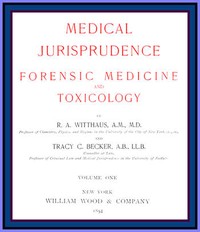
The title page lists sixteen collaborators, including professors of anatomy, clinical surgery, and criminal law, as well as a coroner and a judge. This collective expertise is reflected in the text’s varied registers: legal chapters by Becker and Boston use precise statutory language, while medical chapters by Woolsey, Park, or Loomis employ clinical terminology. The introduction notes that the terms forensic medicine, legal medicine, and medical jurisprudence have been used interchangeably, but the volume’s structure deliberately separates them. The collaborative nature also explains the occasional shifts in citation style and the inclusion of multiple authorities for a single point, such as the two definitions of a wound from Foderé and Taylor.
Readers approaching this volume should expect a reference work that prioritizes classification and precedent over narrative. The detailed table of contents and index allow targeted searches, while the consistent chapter structure—legal context, medical definitions, case applications—facilitates comparison across topics. The excerpts suggest that the authors assume a professional audience familiar with both legal and medical terminology, but the systematic organization makes the material accessible to anyone interested in the historical foundations of forensic science.
That rainy afternoon, I kept returning to the swollen margins scribbled beside the autopsy notes, wondering how a single wound could hold so many legal meanings. The dryness of the text softened, somehow, into something human. Later, I found myself reaching for The Law's Lumber Room (Second Series) — A Closer Reading, and the same quiet curiosity simply followed me there, uninvited but welcome.
There are no reviews for this eBook.
There are no comments for this eBook.
Reader reflection
How will you remember this book?
Save your reaction, strongest insight, and memorable passage.
Your progress
0
/
10
2
Was reading this book enjoyable?
3
Would you recommend this book to another reader?
4
How easy was the book to follow?
5
Did this book create an emotional response?
6
Did the story or argument move comfortably?
7
Did the book give you something worth debating?
8
What did you appreciate most?
9
In one sentence, what did you learn?
10