1

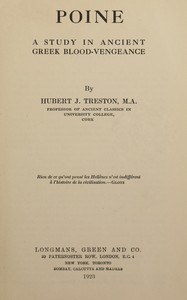
Poine: a study in ancient Greek blood-vengeance — Key Ideas to Explore
(0 User reviews)
331
Project Gutenberg
2022
Not confirmed
Greece -- Civilization; Vendetta; Criminal law (Greek law); Homicide (Greek law); Greek drama (Tragedy) -- History and criticism
Readers of public-domain and historical texts
Project Gutenberg digital edition
en
Edition facts
Words
162,518
Reading time
707 min
Text sections
34
This digital edition of Poine: a study in ancient Greek blood-vengeance — Key Ideas to Explore is described by source-level measurements including 162,518 words, 11 hr 47 min estimated reading time, and 34 detected text sections.
The text analysis averages about 21.9 words per sentence, while the detected sections provide another way to judge how the source is divided.
Project Gutenberg metadata also associates the work with “Greece -- Civilization,” connecting these edition facts with the source record’s subject description.
Source:
Project Gutenberg record #69344
A study of blood-vengeance in ancient Greece, examining Homeric society, the evolution of homicide laws, and the influence of pollution doctrine on Attic tragedy, based on literary and archaeological evidence.
Read the complete public-domain text at its original source.
Read on Project GutenbergTreston opens his study with a clear methodological stance: this is not a technical legal treatise but a supplement to Greek literature, history, and archaeology. He aims to illuminate the social and religious evolution behind the homicide laws, drawing on the work of Ridgeway and Leaf to analyze Homeric civilization. The book is structured in three parts, moving from Homeric society through the Middle Age of Hellenism (1000–600 BCE) to the legends of Attic tragedy. Treston repeatedly emphasizes the literary aspect, even in the most legal sections, and his prose is marked by a careful, argumentative tone that builds toward a central thesis: the historical homicide code represents a compromise between pollution doctrine, tribal wergeld, and state law.
The Compromise Between Pollution and Tribal Custom
Treston’s analysis hinges on a specific legal paradox: in cases of involuntary kin-slaying, the slayer could never re-enter his home, yet for other manslaughters, the relatives of the victim could consent to appeasement after a year’s exile. He traces this to a compromise between the pollution doctrine—which demanded perpetual exile—and older Pelasgian tribal customs that allowed wergeld. The relatives, as interpreters of the dead’s anger, became the “thin end of their old tribal wedge,” negotiating the terms of exile. Treston argues that this reconciliation explains the laws of Draco, Plato’s code, and Demosthenes’ references, though he acknowledges that the evidence is fragmentary and his interpretation is a “solution” that reconciles conflicting sources.
The Role of the Relatives in Legal Procedure
In Treston’s reconstruction, the relatives of the slain held a pivotal role: they could prosecute the slayer if he denied guilt, but if he admitted it, no trial was needed, and appeasement could proceed after a year. This gave them de facto control over the slayer’s return to civic status, a power that the pollution doctrine alone could not enforce. Treston notes a “strange paradox” in Plato’s decrees: a citizen could prosecute a stranger for manslaughter but could not accept appeasement, leaving the relatives as the only medium for reintegration. The author’s language here is precise, using terms like “crevice” and “wedge” to describe how tribal custom survived within state law, and he repeatedly ties his argument to specific legal texts, though he cautions that some decrees may be Platonic inventions rather than historical Attic law.
From Homeric Society to Attic Tragedy
The third part of the book shifts to the legends of Attic tragedy, which Treston argues are “permeated with references to homicide.” He positions this analysis as dependent on the legal framework established earlier, treating the homicide laws as a “necessary preliminary” to understanding the dramatic conflicts. The excerpts show Treston’s method: he moves from legal specifics—such as the distinction between justifiable homicide with neglect (ἀφυλαξία) and that with intent but extenuating passion—to broader cultural patterns. His voice is scholarly but not dry, occasionally using rhetorical questions (“But exile from what State?”) to guide the reader. The work’s structure reflects its dual aim: to advance knowledge of Greek civilization while making the legal material accessible to students of literature and history.
Treston’s study rewards readers who attend to his careful distinctions between pollution, wergeld, and state law. The book’s three-part structure allows for a progressive deepening of the argument, from Homeric social strata to the legal codes of the historical period and finally to the tragic legends. Readers should note that Treston frequently qualifies his claims, acknowledging when evidence is incomplete or when his interpretation is one of several possible reconciliations. This caution, combined with his insistence on the literary dimension, makes the work a valuable resource for those interested in the intersection of law, religion, and narrative in ancient Greece.
There’s something achingly human in tracing how the Furies became the Eumenides, how raw vengeance softened into law. It reminds me of old arguments over Sunday closing hours—rules meant to temper our wilder impulses, yet somehow losing the warmth they were meant to protect. I found myself thinking of that little pamphlet, The New Sunday Liquor Law Vindicated — Inside the Classic, the way it, too, wrestles with order’s quiet cost. Strange, the company old books keep.
There are no reviews for this eBook.
There are no comments for this eBook.
Reader reflection
How will you remember this book?
Save your reaction, strongest insight, and memorable passage.
Your progress
0
/
10
2
What was your overall reaction to the book?
3
Would you recommend this book to another reader?
4
How much effort did this book require?
5
How strongly did the book affect you emotionally?
6
Did the book meet your expectations?
7
Could you follow the author’s main argument?
8
Did the story or argument move comfortably?
9
Which lesson or insight stayed with you?
10