1

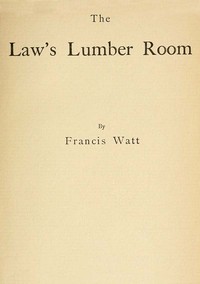
The Law's Lumber Room — Context and Discussion
(0 User reviews)
827
Project Gutenberg
2017
Not confirmed
Law -- Great Britain
Readers of public-domain and historical texts
Project Gutenberg digital edition
en
Edition facts
Words
26,813
Reading time
117 min
Text sections
15
For The Law's Lumber Room — Context and Discussion, the stored edition analysis reports 26,813 words, 1 hr 57 min estimated reading time, and 15 detected text sections.
The text analysis averages about 23.5 words per sentence, while the detected sections provide another way to judge how the source is divided.
Project Gutenberg metadata also associates the work with “Law -- Great Britain,” connecting these edition facts with the source record’s subject description.
Source:
Project Gutenberg record #55724
Francis Watt's 1895 collection examines obsolete English legal practices—benefit of clergy, sanctuary, trial by ordeal, wager of battle, press-gang—tracing their origins, evolution, and eventual relegation to the 'lumber room' of history, with a focus on the language and logic that once made them functional.
Read the complete public-domain text at its original source.
Read on Project GutenbergFrancis Watt opens his 1895 collection with a striking metaphor: the law, like a household, has a lumber room where discarded statutes and forgotten procedures gather dust. The preface immediately establishes a dual tone—scholarly yet wry—as Watt promises to find romance among 'the outworn instruments of cruelty, superstition, terror.' He does not claim to write a comprehensive legal history; instead, he offers glimpses into specific antiquities: benefit of clergy, right of sanctuary, law of the forest, trial by ordeal, wager of battle, and the press-gang. The narrative voice is that of a collector, not a reformer, and the prose shifts between dry exposition and sudden, vivid imagery—such as the 'blood everywhere' that marks the logical extremes of old customs.
The Voice of the Preface: Metaphor and Modesty
The preface is the most personal section of the book. Watt addresses the reader directly, admitting that law 'even when an actual part of the life of to-day is like to prove a tedious thing.' He then defends his project by invoking literary touchstones—Chaucer's Prologue, Macaulay's remark about 'fictions'—and by framing his subjects as 'things of interest' rather than dry statutes. The metaphor of the lumber room recurs, but Watt undercuts any pretension by calling his own work 'little' and noting it originally appeared as magazine contributions. The voice is that of an enthusiast who knows his audience may be skeptical, and he meets that skepticism with a blend of erudition and self-deprecation.
Narrative Pace: From Dry Procedure to Dramatic Anecdote
Watt's prose moves at two speeds. In expository passages, he lays out legal developments with careful chronology—'Under Edward III. the practice went out of use'—and technical terms like Ejectio Firmæ and morte d'ancestor. These sections are dense, demanding close attention. But then the pace shifts abruptly. When describing the fictional ejectment scenario, Watt writes: 'to them so engaged entered B., attracted by their manœuvring, and speedily kicked both into the boundary ditch.' The sudden intrusion of physical comedy—a kick into a ditch—breaks the scholarly tone and gives the reader a concrete image. This alternation between legal abstraction and blunt, almost farcical action is a deliberate structural choice, preventing the material from becoming monotonous.
Recurring Details: John Doe, Richard Roe, and the Persistence of Forms
One of the book's most telling details is the survival of the fictional pledges John Doe and Richard Roe. Watt notes that these names 'lingered on for centuries' in legal forms long after their original function vanished. He traces their origin to the action of ejectment, where they played 'important and serviceable' roles. The persistence of such names, he implies, is characteristic of law's lumber room: forms outlast their meaning. The same pattern appears with the press-gang, which Watt calls 'still a legal possibility' even as he finds it hard to imagine it used. These recurring observations—about the gap between legal language and living practice—give the book a thematic unity beyond its episodic structure.
Watt's collection rewards readers who enjoy watching a patient explicator unpack the logic behind arcane rules. The book does not argue for or against any legal reform; it simply shows how certain procedures once made sense, and how they eventually became curiosities. For the modern reader, the interest lies less in the legal details than in the narrative voice—a late-Victorian mind sifting through the debris of earlier centuries, finding both absurdity and a kind of grim poetry in the law's abandoned machinery.
Sometimes I think about how laws outlive their reasons, like old furniture we keep for comfort. That book on England's discarded legal rituals stayed with me, especially the quiet strangeness of beliefs once taken seriously. It reminded me of Race Distinctions in American Law — A Closer Reading, where similar logic shaped lives, just more painfully. Both left me sitting still afterward, turning pages over in my mind.
There are no reviews for this eBook.
There are no comments for this eBook.
Reader reflection
What did you think of this book?
Answer a few questions and save a private reflection on this device.
Your progress
0
/
10
2
How did the book work for you overall?
3
Would you recommend this book to another reader?
4
How demanding did the text feel?
5
Could you see yourself revisiting this book?
6
How did the pace of the book feel?
7
Did anything about the book feel genuinely new?
8
How useful were the ideas in this book?
9
In one sentence, what did you learn?
10