
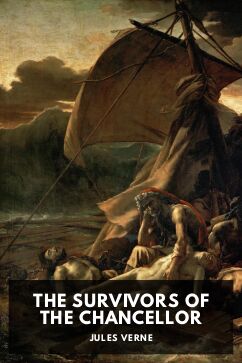
The Survivors of the Chancellor - Jules Verne
Forget the giant squid and the journey to the center of the Earth for a moment. In 'The Survivors of the Chancellor,' Jules Verne trades wonder for pure, unrelenting dread. This is a story that grabs you by the collar and doesn't let go.
The Story
The book is presented as the recovered diary of a passenger, Mr. Kazallon. He boards the British ship Chancellor for a routine Atlantic crossing from Charleston to Liverpool. Almost immediately, things go wrong. A fire breaks out in the cargo hold, and the crew can't put it out. The ship becomes a floating oven. They manage to abandon the burning wreck, only to be crammed onto a lifeboat and then a fragile raft. With little food or water, the survivors face starvation, madness, and the terrifying depths of the open ocean. Verne documents their decline with almost clinical detail, charting the physical and moral decay as hope vanishes.
Why You Should Read It
What makes this book so powerful is its realism. There's no last-minute rescue or convenient island. It's a slow-burn horror story about human limits. You see decent people unravel. The ship's captain, John Silas Huntly, is a fascinating study in a man buckling under impossible pressure. The story forces you to sit with the characters in their despair, making their fleeting moments of hope feel huge. It's less about the sea as a place of adventure and more about it as a vast, indifferent prison. This is Verne at his most psychological and grim, proving he was a master of tension long before the term 'thriller' was coined.
Final Verdict
This book is perfect for readers who love survival stories like 'Lord of the Flies' or 'Alive,' but want a classic, literary punch. It's also a must-read for anyone who thinks of Jules Verne only as a writer of optimistic adventures. Here, his imagination is focused on our darkest instincts. Be warned: it's a tough, bleak journey. But it's one that showcases a different side of a legendary author and will leave you thinking about the thin line between civilization and savagery long after you've finished the last page.
Legal analysis indicates this work is in the public domain. Share knowledge freely with the world.
Linda White
8 months agoFinally a version with clear text and no errors.
Betty Walker
1 year agoFinally a version with clear text and no errors.
Jackson Wright
6 months agoI didn't expect much, but the author's voice is distinct and makes complex topics easy to digest. Worth every second.
Kevin Moore
9 months agoI had low expectations initially, however the arguments are well-supported by credible references. Definitely a 5-star read.





Mary Moore
8 months agoHonestly, the plot twists are genuinely surprising. Worth every second.