1

The Visigothic code — Text and Context
(0 User reviews)
593
Project Gutenberg
2023
Not confirmed
Law, Visigothic; Law, Germanic -- Sources
Readers of public-domain and historical texts
Project Gutenberg digital edition
en
Edition facts
Words
156,194
Reading time
680 min
Text sections
60
For The Visigothic code — Text and Context, the stored edition analysis reports 156,194 words, 11 hr 20 min estimated reading time, and 60 detected text sections.
The text analysis averages about 30.3 words per sentence, while the detected sections provide another way to judge how the source is divided.
Project Gutenberg metadata also associates the work with “Law, Visigothic,” connecting these edition facts with the source record’s subject description.
Source:
Project Gutenberg record #72551
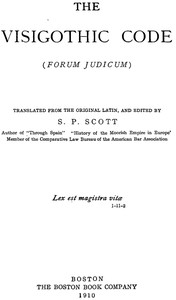
S. P. Scott's 1910 translation of the Visigothic Code (Forum Judicum) presents a legal text from 7th-century Spain. The excerpts reveal a structured, formal voice in laws and a more narrative tone in the preface, with precise penalties and procedures.
Read the complete public-domain text at its original source.
Read on Project GutenbergS. P. Scott's 1910 translation of the Visigothic Code (Forum Judicum) presents a legal document from 7th-century Spain. The excerpts reveal a structured, formal voice in the laws themselves, contrasting with a more narrative and evaluative tone in the editor's preface. The text employs precise language for penalties and procedures, such as specifying fines in solidi and detailing witness requirements for accusations.
Formal Precision in Legal Language
The legal provisions exhibit a meticulous, formulaic style. For instance, the law on torture specifies exact thresholds: a freeborn person may be tortured only if the property value is at least 250 solidi, while an inferior rank or a boar (a term for a low-status person) may be tortured at 100 solidi. The language is conditional and hierarchical, with phrases like "if said freeborn person should be of inferior rank, and a boar." This precision extends to penalties: the judge who fails to exercise moderation pays 200 solidi, and the accuser pays 300 solidi if the tortured person dies. Such details create a systematic, almost mathematical approach to justice.
Narrative Voice in the Preface
The editor's preface adopts a different register—more rhetorical and sweeping. Scott praises the code as "one of the most venerable monuments of jurisprudence" and claims it is "radically different from, and, in many respects superior to, all other collections of legal enactments." This voice is evaluative and historical, contrasting with the impersonal laws. The preface uses broad claims about the Goths' progress from "pastoral and predatory life" to civilization, a narrative absent from the legal text itself. This shift in voice suggests the translator's interpretive framing.
Changes in Pace: From General Principle to Specific Procedure
The excerpts show a notable change in pace between general statements and detailed procedures. The preface moves quickly through historical overview, while the laws slow to a deliberate, step-by-step pace. For example, the law on bringing accusations to the king specifies that if the king is distant, the accuser must draw up a letter in the presence of a messenger and have three witnesses affix seals or signatures. This procedural detail contrasts with the preface's rapid summary. Similarly, the law on mercy begins with a general principle—"we willingly give attention to such appeals"—then immediately restricts it: "We must, however, refuse to interfere when a crime of this kind has been committed against the nation." This shift from broad to narrow mirrors the code's overall structure.
Recurring Legal Concepts: Hierarchy and Retribution
Throughout the excerpts, two recurring concepts stand out: social hierarchy and retributive justice. The laws consistently differentiate by rank: freeborn, respectable freedman, inferior freedman, and boar. Penalties vary accordingly, as seen in the torture laws where fines for mutilation or death are halved for lower-status individuals. Retribution is also central: a false accuser "shall be delivered over into the power of him he accused, that he may himself suffer the penalty." This principle appears in multiple laws, reinforcing a worldview where justice is proportional and often reciprocal. The language of "hatred" and "innocent person" underscores the moral framework.
Readers approaching this translation should attend to the dual voices: the translator's preface, which frames the code as a monument of progress, and the laws themselves, which reveal a rigid, hierarchical society. The precise monetary fines and procedural steps offer a window into Visigothic governance, while the occasional rhetorical flourish in the preface reminds us that this is an early 20th-century interpretation. Comparing the two registers enriches understanding of both the code and its translator.
Reading the precise penalties in the Visigothic Code, I found myself thinking of how even stern rules carry the echo of their time, much like the oddly earnest arguments in The New Sunday Liquor Law Vindicated — Inside the Classic. Both felt like old voices trying to order a world that’s long since moved on, and I lingered quietly on that.
There are no reviews for this eBook.
There are no comments for this eBook.
Reader reflection
Your personal reading reflection
Build a private reading journal entry for this title.
Your progress
0
/
10
2
Did this book hold your interest?
3
Is this a title you would suggest to others?
4
What was the reading difficulty like?
5
How useful were the ideas in this book?
6
How distinctive were its ideas or approach?
7
How personally connected did you feel to the book?
8
Would a second reading be valuable?
9
In one sentence, what did you learn?
10