1

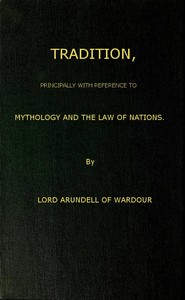
Tradition, Principally with Reference to Mythology and the Law of Nations — Text and Context
(0 User reviews)
45
Project Gutenberg
2014
Not confirmed
Mythology; International law; Natural law; Macdonell, George, 1780-1870; Tradition (Theology)
Readers of public-domain and historical texts
Project Gutenberg digital edition
en
Edition facts
Words
165,890
Reading time
722 min
Text sections
25
The catalog record for Tradition, Principally with Reference to Mythology and the Law of Nations — Text and Context provides practical reading context through 165,890 words, 12 hr 2 min estimated reading time, and 25 detected text sections.
The text analysis averages about 21.3 words per sentence, while the detected sections provide another way to judge how the source is divided.
Project Gutenberg metadata also associates the work with “Mythology,” connecting these edition facts with the source record’s subject description.
Source:
Project Gutenberg record #47127
Lord Arundell of Wardour argues that international law and mythology derive from a continuous tradition originating with Noah, using comparative evidence from explorers, missionaries, and classical sources. The book challenges progressive development theories, asserting that many cultures have degenerated from an original revealed tradition.
Read the complete public-domain text at its original source.
Read on Project GutenbergLord Arundell of Wardour opens his 1872 treatise with a frank admission: the chapters are “necessarily interdependent” and no shortcut to understanding exists. The preface immediately signals a combative, evidence-heavy approach, promising “novelty” in comparing Boulanger’s theory with the travel narratives of Captain Richard Burton and George Catlin. The author’s method is cumulative, weaving together mythology, biblical chronology, and legal philosophy into a single argument about the origin and transmission of human institutions.
The table of contents reveals an ambitious structure: fifteen chapters move from “The Law of Nations” through “Primitive Life,” Egyptian and Assyrian chronology, deluge traditions across Africa and America, to a critique of Sir John Lubbock and Sir Henry Maine. The work is densely annotated, with footnotes renumbered for this edition, and the author warns that their length may give “a repellent aspect” to the pages.
A Tradition of Degeneracy, Not Progress
In the appendix to Chapter XII, Arundell quotes the Rev. Richard Taylor’s account of the New Zealanders to argue that “aboriginal races” have not progressively advanced but have “retrograded, even since the days of Captain Cook.” Taylor’s evidence is specific: the Maori once possessed “large double canoes, decked, with houses on them” similar to those of Tahiti and Hawaii, but “it is now more than half a century since the last was seen.” Finer garments and bark-cloth manufacture have also ceased, though the names survive. Arundell uses this as a counterexample to the “progressive development theory,” claiming that tradition preserves the memory of lost arts and social forms.
The argument hinges on linguistic traces: the Maori have no term for “king,” yet retain words “evidently derived from the very one denoting a king in Tonga.” For Arundell, such remnants prove that tradition outlasts the institutions it describes. He does not claim that the Maori are unique; rather, they exemplify a universal pattern of decline from an original, higher state.
Fire, Words, and the Loss of Things
Arundell’s treatment of the Faakaafo (Fakaofo) people of the Tokelau Islands illustrates his forensic use of ethnographic detail. He notes that while Captain Wilkes reported that these islanders had no fire, Sir John Lubbock and Edward Tylor debated whether their word asi for fire proved they once possessed it. Arundell seizes on the contradiction: “If, then, we have positive evidence that they have not the thing (Wilkes), and also evidence that they have the word (vide note), does not this prove that it is a tradition which they have lost?”
This passage reveals Arundell’s method: he pits one authority against another, then resolves the conflict by invoking tradition as a repository of lost knowledge. The argument is not merely antiquarian; it serves his broader thesis that degeneracy, not progress, explains the gap between primitive and civilized peoples. The reader should note how Arundell uses linguistic evidence as a bridge between material culture and oral memory.
The Noah Hypothesis and the Golden Age
Chapter XIII, “Noah and the Golden Age,” presents the core of Arundell’s theory. He asserts that the law of nations is “part of a tradition” whose “stream has never ceased to flow,” and that this tradition’s “main current” follows channels identified by Cardinal Newman. The metaphor of water is sustained: other reservoirs of tradition have become “stagnant,” like the Bahr-i-Nedjig lake, whose waters are “fresh and sweet” only while connected to the Euphrates but become “unpalatable” when cut off.
Arundell then asks directly: “Whence this tradition arose, and upon what authority and sanction it rests?” His answer is unequivocal: “presumptively it goes back to the commencement of human history, and more demonstrably to that commencement… the era of Noah.” He promises to “inquire how near this theory can be brought to the facts.” The chapter thus functions as a pivot, moving from comparative evidence to a theological-historical claim that the entire edifice of international law and mythology rests on a single antediluvian source.
Reading Against the Grain of the Excerpts
The excerpts provided are heavily weighted toward the later chapters, especially the critique of Lubbock and the Noah hypothesis. The earlier chapters on chronology and primitive life are represented only by their titles. A first reader should be aware that the book’s argument builds slowly: the first five chapters establish a framework for understanding tradition as a source of law and chronology, while the middle chapters test that framework against Egyptian, Assyrian, and global deluge traditions.
Arundell’s style is combative and erudite, frequently engaging with contemporary scholars such as Sir John Lubbock, Sir Henry Maine, and Edward Tylor. He does not hesitate to quote long passages from his sources, then dissect them line by line. The footnotes are essential: they contain counterarguments, additional evidence, and sometimes the very data that undermines his opponents. Readers should treat the notes as part of the main argument, not as mere citations.
Lord Arundell’s Tradition is best approached as a work of synthesis rather than original research. Its value lies in the breadth of sources marshaled—from missionary accounts to classical mythology—and in the clarity with which it articulates a conservative, degenerationist view of human history. Readers interested in Victorian debates about progress, the origins of law, or the intersection of theology and anthropology will find this a rewarding, if demanding, text. The digital edition’s renumbered footnotes and hyperlinked references make navigating the apparatus easier than in the original 1872 printing.
Reading Lord Arundell’s account of an unbroken tradition, passed from Noah through forgotten generations, I found myself thinking of another kind of inheritance—the quiet, stubborn logic in Medical Jurisprudence as it Relates to Insanity, According to the Law of England — Key Ideas to Explore. Both feel like old rooms where certain assumptions, once questioned, shift the whole floor beneath you.
There are no reviews for this eBook.
There are no comments for this eBook.
Reader reflection
How will you remember this book?
Save your reaction, strongest insight, and memorable passage.
Your progress
0
/
10
2
Did this book hold your interest?
3
How likely are you to recommend this book?
4
How much effort did this book require?
5
What did you think about the pace?
6
How well did it match your expectations?
7
Would you like to discuss this book with someone?
8
How clearly were the main ideas presented?
9
In one sentence, what did you learn?
10