1

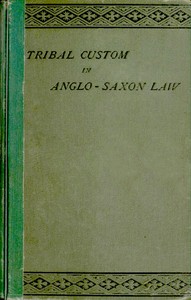
Tribal Custom in Anglo-Saxon Law Being an Essay Supplemental to (1) 'The English Village Community', (2) 'The Tribal System in Wales' — Story, Setting & Ideas
(0 User reviews)
339
Project Gutenberg
2017
Not confirmed
Anglo-Saxons; Law, Anglo-Saxon; Tribes -- Great Britain; Law, Medieval
Readers of public-domain and historical texts
Project Gutenberg digital edition
en
Edition facts
Words
165,145
Reading time
719 min
Text sections
29
Before opening Tribal Custom in Anglo-Saxon Law Being an Essay Supplemental to (1) 'The English Village Community', (2) 'The Tribal System in Wales' — Story, Setting & Ideas, the edition data offers a quick orientation: 165,145 words, 11 hr 59 min estimated reading time, and 29 detected text sections.
The text analysis averages about 21.8 words per sentence, while the detected sections provide another way to judge how the source is divided.
Project Gutenberg metadata also associates the work with “Anglo-Saxons,” connecting these edition facts with the source record’s subject description.
Source:
Project Gutenberg record #56145
Frederic Seebohm's 1902 essay examines Anglo-Saxon law through the lens of tribal custom, using Cymric and Scandinavian evidence to trace family-based legal structures like wergeld and the gwely, with close attention to the language of legal codes and the gradual shift toward individual ownership.
Read the complete public-domain text at its original source.
Read on Project GutenbergFrederic Seebohm’s 1902 essay approaches Anglo-Saxon law not from the familiar manorial perspective but from the standpoint of tribal custom, a shift signaled in the preface as the third part of a trilogy. The work opens by establishing a comparative method: Cymric tribal custom, especially the gwely (family unit) and the galanas (death-fine), is treated as a key to understanding Continental and Anglo-Saxon laws. Seebohm’s language is precise and legalistic, often embedding Latin phrases from the source codes—such as de bonis communibus—to underscore the communal liability of family groups. The narrative voice is that of a scholar assembling evidence piece by piece, with a clear progression from Welsh to Irish to Scandinavian laws before reaching Anglo-Saxon material.
The Comparative Framework and Its Linguistic Texture
Seebohm’s method is explicitly comparative: he examines Cymric, Irish, Burgundian, Wisigothic, Salic, and Scandinavian laws in sequence, using each to illuminate the next. The language of the essay reflects this layered approach, with frequent code-switching between English and Latin quotations from legal texts. For instance, in discussing Scanian law, he reproduces clauses like Universos contingit de communi consortio quicquid vel culpa amittitur vel industria conquiritur singulorum, then provides his own translation. This bilingual texture is not decorative; it allows readers to see the original wording and assess Seebohm’s interpretation. The author’s voice is cautious, often qualifying claims with phrases like “seem to throw light upon” or “we may fairly conclude,” signaling that the evidence is suggestive rather than definitive. The preface itself notes that each essay is “independent and complete in itself,” yet the cross-references create a cumulative argument about the persistence of tribal principles across different Germanic and Celtic societies.
The Gwely, the Odal, and the Language of Family Ownership
Central to Seebohm’s analysis is the concept of family-based landholding, expressed through terms like the Cymric gwely and the Norse odal. He traces how these units functioned as collective property, with the paterfamilias and those in communione sharing both gains and losses. A striking example comes from Scanian law: if stolen goods are found in a house, double value is taken “not from the portion of the paterfamilias alone, but from the common property.” Seebohm’s commentary emphasizes the solidarity implied by such rules—the family group is a single economic and legal entity. He also notes the gradual erosion of this system: in Gulathing law, sons may buy back their father’s share of the odal at a reduced price, a provision that “seems to throw light upon the traditional principle” while also marking a shift toward individual ownership. The language here is technical but clear, with Seebohm carefully distinguishing between different Scandinavian codes and their varying degrees of tribal survival.
Wergeld, Ordeal, and the Pace of Legal Change
Seebohm’s treatment of wergeld and ordeal illustrates his attention to procedural detail. He explains that the death-fine serves as a “test of the position of classes in tribal society,” and he examines the currencies in which wergelds were stated. The discussion of the Scanian ordeal is particularly vivid: three forms are described—walking on twelve red-hot ploughshares, carrying an iron twelve feet, or carrying it nine paces—with the hands or feet then wrapped and sealed until the sabbath. Seebohm notes that this clause helps date the Latin version, since the ordeal was abolished in 1215. Such concrete details ground the abstract legal principles in specific practices. The author’s pace is deliberate, moving from one legal code to another, but he occasionally pauses to highlight a telling phrase, such as the Scanian law’s reason for collective liability: “since all expect gain from the detention [of the thing stolen] it is not strange if all sustain loss.” These moments of quotation give the reader direct access to the reasoning of medieval lawmakers.
Readers approaching this essay should be prepared for a dense, comparative argument that assumes familiarity with earlier works in the trilogy. Seebohm’s method rewards careful attention to his use of Latin quotations and his cautious phrasing. The book is best read alongside the legal texts he cites, as his analysis often hinges on the precise wording of clauses. Those interested in the transition from tribal to individual ownership will find a wealth of specific examples, though the incomplete excerpts leave the full arc of the argument—especially the Anglo-Saxon chapters—only partially visible.
That grey afternoon, Seebohm’s careful tracing of the gwely felt like watching rain find its own level—every customary path leading back to kin, not land. Later, closing it, my hand drifted to another spine, and I found myself inside Ancient law — Background and Themes, where early codes breathe the same familial air. One book simply opened into the next, no map needed.
There are no reviews for this eBook.
There are no comments for this eBook.
Reader reflection
What did you think of this book?
Answer a few questions and save a private reflection on this device.
Your progress
0
/
10
2
How did the book work for you overall?
3
Would you encourage someone else to read it?
4
How easy was the book to follow?
5
Could you see yourself revisiting this book?
6
Did the book offer a fresh perspective?
7
Did the book meet your expectations?
8
How useful did the reading feel?
9
What is the main idea you are taking away?
10