1

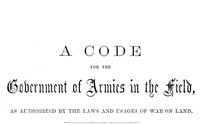
A Code for the Government of Armies in the Field, as authorized by the laws and usages of war on land. — Story, Setting & Ideas
(0 User reviews)
816
Project Gutenberg
2016
Not confirmed
United States. Army -- Regulations; Military law -- United States
Readers of public-domain and historical texts
Project Gutenberg digital edition
en
Edition facts
Words
11,190
Reading time
49 min
Text sections
10
Before opening A Code for the Government of Armies in the Field, as authorized by the laws and usages of war on land. — Story, Setting & Ideas, the edition data offers a quick orientation: 11,190 words, 49 min estimated reading time, and 10 detected text sections.
The text analysis averages about 29.1 words per sentence, while the detected sections provide another way to judge how the source is divided.
Project Gutenberg metadata also associates the work with “United States. Army -- Regulations,” connecting these edition facts with the source record’s subject description.
Source:
Project Gutenberg record #53699
Francis Lieber's 1863 code defines martial law, military necessity, and rules for spies, traitors, and prisoners of war, offering a precise legal framework for Union armies during the Civil War.
Read the complete public-domain text at its original source.
Read on Project GutenbergFrancis Lieber's 1863 code opens with a stark definition: 'Martial Law is the immediate and direct effect and consequence of occupation or conquest.' The first sections establish that a hostile army's presence alone proclaims martial law, without need for a proclamation. Lieber distinguishes martial law from 'military oppression,' calling it 'temporary Military Absolutism' that must not degenerate into 'arbitrary despotism.' This careful framing sets the tone for a document that seeks to impose legal order on the chaos of war.
Defining Military Necessity and Its Limits
Lieber's code anchors itself in the concept of 'Military Necessity,' which he defines as measures 'indispensable for the obtaining of the ends of the war' and 'lawful according to the modern law and usages of war.' This dual requirement—both necessary and lawful—imposes a constraint on commanders. The code does not elaborate further on what constitutes 'modern law and usages,' leaving room for interpretation. Readers should note that this definition appears early, in §5, and serves as a touchstone for later articles on retaliation, treatment of prisoners, and conduct toward civilians. The code's structure suggests that every subsequent rule is meant to be read as an application of this principle.
Spies, Traitors, and the Death Penalty
The code devotes several sections to espionage and treason, prescribing death by hanging for spies (§55) and death for traitors (§56). A spy is defined as one who 'secretly, in disguise or under false pretence, seeks information with the intention of communicating it to the enemy.' Notably, the code extends this definition to messengers carrying despatches in enemy territory (§58) and to bearers of flags of truce who abuse their 'sacred character' (§59). It also states that 'the Law of War... makes no difference on account of the difference of sexes' concerning spies, traitors, or war-rebels (§60). These provisions reflect the urgency of the Civil War context, where loyalty and information were paramount.
Rules for Prisoner Exchange and Flags of Truce
The code establishes a structured system for exchanging prisoners: 'number for number—rank for rank—wounded for wounded' (§62). Prisoners are 'in honor bound truly to state to the captor his rank' (§64), and those who misrepresent their rank face punishment. The code also addresses flags of truce, emphasizing their 'sacred' character and the need for 'great caution' in convicting bearers of abuse (§59). These sections reveal a concern for maintaining order and trust even amid conflict. The detailed rules suggest that Lieber envisioned a war governed by reciprocal obligations, where even enemies could negotiate within a legal framework.
The Code's Structure and Intended Audience
Originally printed as a manuscript for a War Department board, the code is organized into numbered sections grouped under headings like 'MARTIAL LAW. MILITARY NECESSITY. RETALIATION.' and 'EXCHANGE OF PRISONERS. FLAGS OF TRUCE. FLAGS OF PROTECTION.' This structure mirrors legal codifications, making it easy to reference. The language is precise and declarative, often using 'is' and 'are' to state rules as facts (e.g., 'The spy is punished with death by hanging by the neck'). The intended audience appears to be military commanders and officers, who would need clear, actionable directives. Readers should approach the text as a regulatory document, not a narrative, and pay attention to the definitions that precede each set of rules.
As you read, note how Lieber balances the demands of military necessity with the constraints of law. The code's numbered paragraphs invite comparison: how does the treatment of spies differ from that of prisoners of war? Where does the code allow discretion, and where does it mandate punishment? These distinctions reveal the document's underlying philosophy—that even in war, there are limits that must be observed.
I was thinking about Lieber’s code, how carefully it tried to pin down what mercy meant during war, and it made me remember another kind of boundary, one written into Leviticus. There is something tender in that old worry about a sister and a husband, a rule meant to hold a family close. Odd, how both books wrestle with the shape of duty—Marriage with a deceased wife's sister Leviticus XVIII. 18, considered in connection with the Law of the Levirate — Edition Insights—and leave me wondering at the quiet firmness of human law.
There are no reviews for this eBook.
There are no comments for this eBook.
Reader reflection
How did this book work for you?
Your answers remain private and are stored only in this browser.
Your progress
0
/
10
2
What was your overall reaction to the book?
3
Would you recommend this book to another reader?
4
How demanding did the text feel?
5
Did the story or argument move comfortably?
6
How much did the book move you?
7
Did the book offer a fresh perspective?
8
Did the book deliver what you hoped for?
9
In one sentence, what did you learn?
10