1

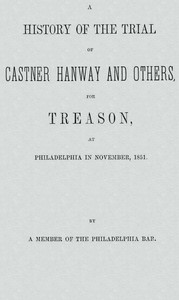
A History of the Trial of Castner Hanway and Others, for Treason, at Philadelphia in November, 1851 With an Introduction upon the History of the Slave Question — Background and Themes
(0 User reviews)
234
Project Gutenberg
2018
Not confirmed
United States -- Fugitive slave law (1850); Trials (Treason) -- Pennsylvania -- Philadelphia; Riots -- Pennsylvania -- Christiana; Hanway, Castner, 1821-1893 -- Trials, litigation, etc.; Fugitive slaves -- Legal status, laws, etc. -- United States
Readers of public-domain and historical texts
Project Gutenberg digital edition
en
Edition facts
Words
35,965
Reading time
157 min
Text sections
6
This digital edition of A History of the Trial of Castner Hanway and Others, for Treason, at Philadelphia in November, 1851 With an Introduction upon the History of the Slave Question — Background and Themes is described by source-level measurements including 35,965 words, 2 hr 37 min estimated reading time, and 6 detected text sections.
The text analysis averages about 25.2 words per sentence, while the detected sections provide another way to judge how the source is divided.
Project Gutenberg metadata also associates the work with “United States -- Fugitive slave law (1850),” connecting these edition facts with the source record’s subject description.
Source:
Project Gutenberg record #57255
A contemporary account of the 1851 Christiana treason trials, compiled by a Philadelphia lawyer from court records and newspaper reports, focusing on the legal proceedings and the contentious atmosphere surrounding the Fugitive Slave Act.
Read the complete public-domain text at its original source.
Read on Project GutenbergThe anonymous author, a member of the Philadelphia bar, opens this pamphlet by explaining its origin: a phonographic report of the Christiana treason trials was taken by order of the court but never published in full. The present work aims to fill that gap, drawing on official dockets, prison records, and the writer's own recollections. The preface also takes aim at a rival pamphlet by Mr. Brent, which the author dismisses as a vehicle for 'spleen and mortification' rather than a fair account. This combative tone signals that the narrative is not neutral but shaped by the author's legal perspective and evident frustration with the prosecution's conduct.
The Author's Sources and Stated Purpose
The preface lists the documentary foundations of the pamphlet: the phonographic trial transcript, dockets from Alderman Reigart and Commissioner Ingraham, records of the Philadelphia County Prison and the federal courts, and files of the Evening Bulletin. Where these sources left gaps, the author relied on his own memory or that of friends who attended the trial. This explicit disclosure of method is unusual for a partisan pamphlet and suggests an effort to establish credibility. The author also notes that Mr. Brent's competing report had a 'very limited circulation' and was issued 'by the authority of the State,' implying that the present work is a corrective to official bias. The preface thus frames the pamphlet as both a public service and a rebuttal.
Prison Conditions and Witnesses' Escape
The author describes the Moyamensing Prison as 'badly ventilated and miserably heated,' with cells lacking fires during cold weather. Some prisoners 'predisposed to pulmonary complaints' suffered severely, and the court eventually ordered better quarters for two of them. A more dramatic episode involves the escape of two prosecution witnesses from the Debtors' Apartment on November 9, 1851. They used their cell shutters and blankets to flee, accompanied by a white man held on another charge. The District Attorney sought a writ of habeas corpus for the runaways, but the defense argued the escape actually harmed their clients, as the missing witnesses might have helped the accused. The author mocks the prosecution's claim that the witnesses would not flee because they received $1.25 per day, retorting that 'most men, whatever their complexion, would prefer the light and air of heaven at 50 cents per day, to a cell 8 by 12.'
Contradictions in Official Accounts
The author highlights a telling inconsistency between two official narratives of the escape. One official insinuated that the witnesses were 'assisted from without,' while another claimed 'assistance came from within.' The author points out that the witnesses were under the 'strict and especial charge of the government officers,' making outside help unlikely. He also notes that Moyamensing was 'notoriously insecure,' with iron bars merely set into mortar that a prisoner could remove with a knife. By juxtaposing these details, the author undermines the prosecution's insinuations of conspiracy and shifts suspicion onto the prison's own lax security. This pattern of exposing contradictions recurs throughout the pamphlet, reflecting the author's legal training and his aim to discredit the government's case.
Readers should approach this pamphlet as a lawyer's brief, not a dispassionate history. The author's selection of details—from the prison's poor ventilation to the escape of witnesses—serves to highlight what he sees as prosecutorial overreach and official incompetence. The work is valuable for its contemporary perspective on the tensions surrounding the Fugitive Slave Act, but its partisan origins mean that every claim should be weighed against other sources. The author's own acknowledgment of relying on memory and friends' accounts is a reminder of the limits of this record.
That trial transcript stayed with me—how a courtroom can hold a whole nation’s tension in one room. It made me think of how we remember lawless edges, too. The Story of the Outlaw: A Study of the Western Desperado — Text and Context lingered the same quiet way, less about verdicts than about the shadows we cast on our own heroes.
There are no reviews for this eBook.
There are no comments for this eBook.
Reader reflection
How did this book work for you?
Your answers remain private and are stored only in this browser.
Your progress
0
/
10
2
How much did you enjoy the reading experience?
3
Would you recommend this book to another reader?
4
What was the reading difficulty like?
5
How closely did the book connect with your experience?
6
How would you rate its originality?
7
Could you follow the author’s main argument?
8
How strongly did the book affect you emotionally?
9
In one sentence, what did you learn?
10