1

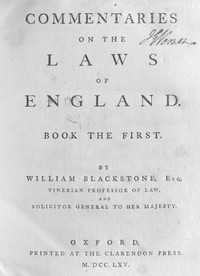
Commentaries on the Laws of England, Book the First — Story, Setting & Ideas
(0 User reviews)
340
Project Gutenberg
2009
Not confirmed
Law -- England -- History; Law -- England
Readers of public-domain and historical texts
Project Gutenberg digital edition
en
Edition facts
Words
171,933
Reading time
748 min
Text sections
30
This digital edition of Commentaries on the Laws of England, Book the First — Story, Setting & Ideas is described by source-level measurements including 171,933 words, 12 hr 28 min estimated reading time, and 30 detected text sections.
The text analysis averages about 33.6 words per sentence, while the detected sections provide another way to judge how the source is divided.
Project Gutenberg metadata also associates the work with “Law -- England -- History,” connecting these edition facts with the source record’s subject description.
Source:
Project Gutenberg record #30802
Blackstone's Commentaries, Book the First, examines English law through the lens of royal prerogative, property, and personal rights, using historical examples and a structured, analytical style that moves from abstract principles to concrete applications.
Read the complete public-domain text at its original source.
Read on Project GutenbergBlackstone opens Book the First by grounding English law in the king's political capacity, describing the sovereign as "all-perfect and immortal in his kingly capacity" and tracing the legal fiction that "the king never dies." This assertion of perpetuity sets the stage for a methodical exploration of royal prerogative, property, and the rights of persons. The work moves from abstract principles—such as the king's "absolute immortality"—to concrete historical examples, like the regencies of Henry III and Edward VI, illustrating how legal theory is applied across centuries.
The King's Two Bodies and Legal Perpetuity
Blackstone devotes careful attention to the doctrine of the king's two bodies: the natural body, which can die, and the political body, which is perpetual. He explains that upon a monarch's natural death, the kingship is "vested at once in his heir" without any interregnum, using the term "demise" to describe a transfer of property rather than a death. This legal fiction is supported by references to Plowden and historical instances, such as Edward IV's temporary displacement in 1470, which was legally treated as a demise. The structure here is typical: a general principle is stated, then buttressed by case law and historical precedent, creating a layered argument that moves from the abstract to the concrete.
Regency and the Governance of Minors
A recurring pattern in Blackstone's method is the use of historical regencies to test legal principles. He catalogs the ages at which various kings assumed power—Henry III at nine, Edward III at fifteen, Richard II at eleven—and the parliamentary or council mechanisms that governed during their minorities. The discussion of Henry V's deathbed appointment of a regent, later altered by parliament, shows Blackstone's interest in the tension between royal will and legislative authority. These examples are not merely illustrative; they serve as evidence for the evolving definition of "pupillage" and the limits of royal power, a theme that recurs throughout the book.
Prerogative and the Executive Power
Blackstone frames the royal prerogative as the "executive part of government," wisely placed in a single hand for "unanimity, strength and dispatch." He contrasts this with the potential weakness of multiple wills, a point he reinforces through a logical chain: many wills create disunity, which weakens government. This section exemplifies his structural approach: a clear thesis, followed by a reasoned argument that draws on both legal theory and practical governance. The language is precise, with terms like "all-perfect" and "immortal" used to emphasize the king's political role, while the historical examples ground the discussion in real cases.
From Abstract Principles to Concrete Rights
Throughout Book the First, Blackstone moves from the sovereign's attributes to the rights of subjects, a transition that mirrors the book's overall structure. The discussion of the king's perpetuity leads naturally to an examination of property and personal rights, though the excerpts provided focus primarily on the former. The author's voice is authoritative yet explanatory, often using phrases like "we are next to consider" to guide the reader through a logical progression. This methodical approach, combined with a reliance on historical precedent and legal citation, gives the work a distinctive rhythm: principle, example, and application.
Readers approaching Book the First should attend to Blackstone's habit of moving from broad legal axioms to specific historical cases, a technique that makes the abstract tangible. The work rewards those who follow its layered arguments, where each principle is tested against precedent. Pay particular attention to the recurring tension between royal authority and parliamentary oversight, a thread that runs through the discussions of regency and prerogative. Blackstone's prose, though dense, is structured to guide the reader step by step through the foundations of English law.
Sometimes I think about how Blackstone's old laws feel like rooms we still walk through. The way he maps rights and power, slowly, brick by brick—it stayed with me. I found that same quiet patience in The Constitution of Japan, 1946 — A Reader’s Guide, where a nation draws its own blueprint for dignity. Strange how two far-apart worlds can echo so softly.
There are no reviews for this eBook.
There are no comments for this eBook.
Reader reflection
What was your reading experience?
Capture what you thought, learned, and would like to remember.
Your progress
0
/
10
2
What was your overall reaction to the book?
3
Is this a title you would suggest to others?
4
What was the reading difficulty like?
5
How strong was your personal connection to the text?
6
How useful did the reading feel?
7
How distinctive were its ideas or approach?
8
Did the book deliver what you hoped for?
9
What changed or sharpened your thinking?
10