1

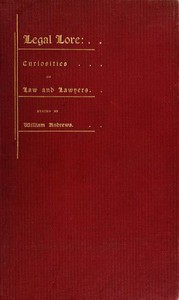
Legal Lore: Curiosities of Law and Lawyers — Text and Context
(0 User reviews)
72
Project Gutenberg
2012
Not confirmed
Law -- Miscellanea
Readers of public-domain and historical texts
Project Gutenberg digital edition
en
Edition facts
Words
61,701
Reading time
269 min
Text sections
7
Legal Lore: Curiosities of Law and Lawyers — Text and Context can be approached with a clearer sense of reading commitment from its source measurements: 61,701 words, 4 hr 29 min estimated reading time, and 7 detected text sections.
The text analysis averages about 25.4 words per sentence, while the detected sections provide another way to judge how the source is divided.
Project Gutenberg metadata also associates the work with “Law -- Miscellanea,” connecting these edition facts with the source record’s subject description.
Source:
Project Gutenberg record #38589
An 1897 collection of essays on legal oddities, from Bible law and animal trials to feudal tenures and gipsy regulations, edited by William Andrews. Each chapter examines a specific curiosity through historical records, statutes, and anecdotes, revealing the quirks and evolution of legal systems.
Read the complete public-domain text at its original source.
Read on Project GutenbergWilliam Andrews opens Legal Lore with a preface noting that the book follows his earlier volume The Lawyer in History, Literature, and Humour. The contents page lists seventeen chapters by various contributors, each tackling a distinct legal curiosity. The first chapter, “Bible Law” by S. Burgess, immediately confronts the risk of irreverence when discussing scriptural legal codes. This self-aware, scholarly tone recurs throughout the collection, as authors balance historical detail with a light touch appropriate for “the lighter literature of the law,” as The Times described Andrews’s previous work.
Animal Defendants and Witnesses
The chapter “Trials of Animals” recounts a 1572 case in Nancy where a pig was led by cord to a cross near the cemetery, tied, and left for execution. The report specifies that the pig was “a brute beast” and that the mayor and justice held a conference at that spot. Such procedural formality extended to a cock tried at Basle for laying an egg, accused of sorcery. The advocate argued no evil animus had been proved and that the act was involuntary. The prosecutor countered by citing the Gadarene swine, who were “involuntary agents” yet punished. The cock was burned at the stake. The chapter also notes that in some Swiss jurisdictions, a householder who killed a burglar at night had to produce a domestic animal as witness and swear innocence in its presence; if the animal did not contradict him, he was acquitted.
The Vocabulary of Legal Procedure
Several chapters highlight the precise language used in old statutes and court records. In “Bible Law,” Burgess carefully distinguishes between Mosaic precepts and later interpretations, using terms like “verbal inspiration” to frame the difficulty. The trial report from Nancy includes the phrase “without prejudice to the judicial rights of the lord,” a formula that underscores the layered jurisdictions of feudal law. In “Cockieleerie Law,” Robert Bird employs Scots legal terms that echo the chapter’s title, a reference to a local custom. The editor’s own preface speaks of “byways of literature,” signaling that the collection values lexical curiosities as much as historical ones.
Feudal Tenures and Manor Law
Chapters such as “Law Under the Feudal System” and “The Manor and Manor Law” examine how land ownership shaped legal obligations. England Howlett’s contributions detail ancient tenures that required tenants to perform specific services—like providing a rose or a pair of gloves—rather than paying rent. These obligations were recorded in manorial rolls, and the authors quote from them to show how law was embedded in daily life. The chapter “Laws of the Forest” by Edward Peacock discusses the special jurisdiction of royal forests, where game laws were enforced with distinct penalties. Together, these essays illustrate a legal landscape where local custom often trumped central statute.
Punishment and Its Documentation
Sidney W. Clarke’s “Barbarous Punishments” catalogs methods of execution and mutilation from medieval to early modern times, drawing on court records and chronicles. The chapter avoids sensationalism by focusing on the legal rationale behind each penalty. Similarly, “Fatal Links” by Ernest H. Rann examines cases where circumstantial evidence—a chain of small facts—led to convictions. The authors consistently cite specific sources: M. Berriat St. Prix’s list of animal trials, Lionnois’s history of Nancy, Ruchat’s history of the Reformation in Switzerland. This reliance on documented evidence gives the collection a scholarly foundation even when the subject matter is macabre or absurd.
Readers interested in the evolution of legal procedure will find that Legal Lore rewards attention to the footnotes and source citations scattered through each chapter. The essays were written by different hands, so the style shifts from Burgess’s cautious theological analysis to Neilson’s crisp historical summaries. Approaching the book as a series of independent articles—each with its own bibliography—allows one to appreciate the range of legal oddities without expecting a unified argument.
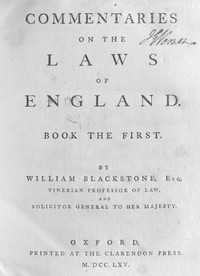
Reading about medieval animal trials took me back to my grandfather’s old law books, and that same feeling of strange, dusty logic. It reminded me of the careful way Blackstone once mapped the quiet corners of English law. In that spirit, I found Commentaries on the Laws of England, Book the First — Story, Setting & Ideas, which felt like sitting beside him, listening to gentle, ordered certainties.
There are no reviews for this eBook.
There are no comments for this eBook.
Reader reflection
What was your reading experience?
Capture what you thought, learned, and would like to remember.
Your progress
0
/
10
2
How much did you enjoy the reading experience?
3
How likely are you to recommend this book?
4
Did the language feel accessible?
5
How much did the book move you?
6
Did you gain anything practical from the text?
7
What did you appreciate most?
8
Could you see yourself revisiting this book?
9
What changed or sharpened your thinking?
10