1

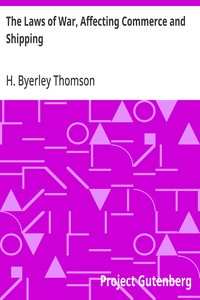
The Laws of War, Affecting Commerce and Shipping — Reading Notes
(0 User reviews)
86
Project Gutenberg
2004
Not confirmed
War (International law); War, Maritime (International law); Maritime law
Readers of public-domain and historical texts
Project Gutenberg digital edition
en
Edition facts
Words
39,021
Reading time
170 min
Text sections
5
For The Laws of War, Affecting Commerce and Shipping — Reading Notes, the stored edition analysis reports 39,021 words, 2 hr 50 min estimated reading time, and 5 detected text sections.
The text analysis averages about 25.2 words per sentence, while the detected sections provide another way to judge how the source is divided.
Project Gutenberg metadata also associates the work with “War (International law),” connecting these edition facts with the source record’s subject description.
Source:
Project Gutenberg record #13858
An 1854 legal treatise examining the laws of war as they apply to maritime commerce, focusing on prize, ransom, recapture, salvage, neutrality, and contraband. The author, a barrister, balances concise practical guidance with evolving international norms, drawing on English and European precedents.
Read the complete public-domain text at its original source.
Read on Project GutenbergH. Byerley Thomson, a barrister of Jesus College, Cambridge, and the Inner Temple, frames his 1854 treatise as a practical guide for merchants and shipowners navigating the legal complexities of war at sea. The preface to this second edition stresses that the work retains a “concise and popular character” while expanding into fresh topics. Thomson does not merely restate rules; he traces how English law shifted from the ancient twenty-four-hour rule of possession to a more commercial, restitution-oriented approach, a change he links directly to the growth of British trade.
A Barrister’s Voice: Precision and Practicality
Thomson’s prose is that of a legal practitioner addressing a mercantile audience. He avoids abstract theorizing, opening his introduction by dismissing “theoretical discussion on the origin of the Law of Nations” as superfluous in a concise practical treatise. Instead, he grounds his arguments in the rulings of “Maritime Tribunals,” which he calls “almost the sole interpreters and mouthpieces of the International Law.” His diction is exact: he distinguishes between “right and power of possession” and “right of property,” a distinction central to his analysis of recaptures. The author’s tone is authoritative yet accessible, using sidenotes to flag topics like “Recaptures” and “Salvage” for quick reference.
The Shifting Ground of Property at Sea
Thomson devotes careful attention to the question of when a prize becomes the captor’s full property. He notes that by “the universal law of nations,” the captor gains possession but not full ownership until peace is declared. This principle, he argues, means that “every recapture, made at any period of the war whatever” should be restored to the original owner upon payment of salvage. He contrasts this with the “ancient law of England,” under which twenty-four hours’ possession sufficed to divest the original owner. The shift, he explains, occurred during the “usurpation” of 1649, when England’s growing commerce prompted a more lenient rule. Thomson’s treatment of salvage as a form of general average—shared among ship, freight, and cargo—shows his effort to translate legal doctrine into practical financial terms.
Neutrality, Contraband, and the Limits of Search
In the sections on neutrality and contraband, Thomson addresses the rights and obligations of neutral vessels. He outlines the doctrine of continuous voyage and the evolving list of contraband articles, which he appends in a note. His discussion of blockades and the right of search reflects the tension between belligerent rights and neutral commerce. Thomson does not shy from acknowledging that “the rule of 1756” and other precedents have been contested, and he includes a note on “Armed Neutralities” to show how coalitions of neutrals have pushed back against maritime powers. The author’s method is to present the law as it stands, while hinting at the pressures that may reshape it.
Structure as Argument: The Architecture of the Treatise
Thomson organizes his work into chapters that move from the commencement of war to its effects on enemies, prizes, licences, ransom, and recaptures, then to neutrality and blockades. This sequence mirrors the chronological experience of a merchant: first the outbreak of war, then the seizure of property, then the possibilities of ransom or recapture, and finally the constraints of neutral trade. The appendixes—on reprisals, the War Bill Act, the Rule of 1756, and contraband lists—function as a legal toolkit. The author’s promise of a second part on army, navy, and militia law suggests he saw this volume as only half the picture. The index, added for this edition, underscores his commitment to utility.
Thomson’s treatise is best read as a snapshot of mid-nineteenth-century maritime law in flux, shaped by Britain’s commercial interests and the legacy of the Napoleonic Wars. Readers interested in the interplay between legal doctrine and economic policy will find his precise distinctions—between possession and property, or between ancient and modern salvage rules—particularly revealing. The work rewards attention to its footnotes and appendixes, where the author’s research into specific cases and declarations comes to the fore.
I found myself drifting through the dry, precise margins of The Laws of War last evening, noting how the barrister's careful rules on salvage felt like worn stones in a well-trodden path. Strange, then, that my hand reached for Legal Lore: Curiosities of Law and Lawyers — Text and Context beside it, as if the profession’s stern face needed a knowing wink. There is a warmth in oddities that statutes never quite capture.
There are no reviews for this eBook.
There are no comments for this eBook.
Reader reflection
Your personal reading reflection
Build a private reading journal entry for this title.
Your progress
0
/
10
2
What was your overall reaction to the book?
3
Is this a title you would suggest to others?
4
How easy was the book to follow?
5
Did it raise ideas you would like to talk about?
6
Was the book what you thought it would be?
7
Could you see yourself revisiting this book?
8
Could you follow the author’s main argument?
9
What is the main idea you are taking away?
10