1

A translation of Glanville — Reading Companion
(0 User reviews)
569
Project Gutenberg
2023
Not confirmed
Law -- England; Law, Medieval -- Sources
Readers of public-domain and historical texts
Project Gutenberg digital edition
en
Edition facts
Words
94,130
Reading time
410 min
Text sections
27
This digital edition of A translation of Glanville — Reading Companion is described by source-level measurements including 94,130 words, 6 hr 50 min estimated reading time, and 27 detected text sections.
The text analysis averages about 23.6 words per sentence, while the detected sections provide another way to judge how the source is divided.
Project Gutenberg metadata also associates the work with “Law -- England,” connecting these edition facts with the source record’s subject description.
Source:
Project Gutenberg record #71142
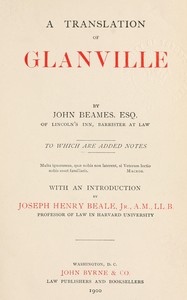
John Beames's 1900 translation of the 12th-century legal treatise attributed to Ranulf de Glanville, with an introduction by Joseph Henry Beale, Jr., detailing the procedures and writs of the King's Court, Exchequer, and justices.
Read the complete public-domain text at its original source.
Read on Project GutenbergJohn Beames's translation of the treatise traditionally ascribed to Ranulf de Glanville presents the laws and customs of England under Henry II as they were pleaded in the King's Court, the Exchequer, and before justices. The work is structured around writs—formal commands that initiate legal actions—and the procedures that follow. Beames's English renders the original Latin into a precise, legalistic prose that preserves the formulaic character of medieval writs, such as the repeated phrase 'I command you, that without delay, you hold full Right.'
Joseph Henry Beale's introduction situates Glanville as a key figure in the development of English common law, detailing his career as sheriff, judge, and chief justiciar. The translation itself is accompanied by notes that clarify points of law and reference earlier sections, creating a self-contained reference for readers interested in the mechanics of 12th-century litigation.
The Writs as Structural Backbone
The treatise is organized around the writ, a royal command that sets a legal process in motion. Each writ is quoted in full, with variations for different circumstances—land, service, rent—and the text explains how the writ determines the jurisdiction and procedure. For example, a writ of right for land is directed to the lord of whom the claimant holds, while a writ concerning service addresses the tenant directly. The repetitive structure of the writs, with their conditional clauses ('if the Plea concern Land, such Writ will be as follows'), gives the work a procedural logic that is both systematic and formulaic.
Beames's translation preserves this formulaic quality, using consistent phrasing for recurring elements like 'free service' and 'deforced him.' The notes cross-reference earlier books, such as the discussion of essoins (excuses for non-appearance) in Book I, creating a network of procedural rules that the reader must navigate. This structure reflects the treatise's purpose: to provide a practical guide for those who must plead in the king's courts.
The Language of Authority and Precision
Beames's translation employs a formal, legal diction that mirrors the authority of the original. Phrases like 'hold full Right' and 'without delay' recur as commands, while the use of 'shall' and 'may' distinguishes mandatory from discretionary actions. The text is dense with technical terms—'essoins,' 'deforced,' 'cellarii'—that are explained in footnotes but left untranslated in the main body, preserving the specialized vocabulary of medieval law.
The dialogue of the court is rendered in indirect speech, with the king's voice appearing only through the writs. The treatise itself speaks in a declarative, third-person style: 'It should also be observed, that Abbots and Priors of Canons Regular are received in Court, upon their own authority.' This impersonal tone underscores the treatise's claim to describe settled custom rather than individual opinion.
The Role of the Commentator and Translator
Joseph Henry Beale's introduction provides a biographical sketch of Glanville, emphasizing his political and military career—his capture of William the Lion at Alnwick, his service as ambassador to Flanders—and his rise to chief justiciar. Beale treats Glanville as the likely author, noting that 'the present work contains those Laws and Customs only, according to which Pleas are determined in the King’s Court.' This framing positions the treatise as an authoritative record of practice, not a theoretical work.
John Beames, the translator, was a barrister of Lincoln's Inn, and his translation was originally published in 1812. The 1900 edition includes Beames's notes, which cite earlier legal authorities and clarify ambiguities. For instance, a note on the reception of attorneys explains that 'a different Rule prevails where, urged by an order of the Court, or by a Distress, a person prays to put another in his place.' These notes bridge the gap between medieval and modern legal concepts.
Procedural Nuances and the Hierarchy of Courts
The treatise distinguishes between pleas commenced in the King's Court and those that begin in lower courts but may be removed to the King's Court when justice is not done. Book XII explains that 'some Pleas of Right, although not in the first place commenced in the King’s Court, are sometimes removed there, when the Courts of different Lords are proved to have failed in doing Justice.' This hierarchy is enforced through the writ system: a plaintiff must first seek remedy from the lord of the fee, and only if that fails can the case be transferred via the county court to the king's justices.
The text also details the rules for representation in court. Abbots and priors of certain orders may appear without letters from their convents, while others require authorization. The Master of the Knight-Templars and the Chief Prior of the Hospital of Jerusalem are 'received upon their own authority,' but inferior members of those orders are not. These distinctions reflect the social and ecclesiastical hierarchies that shaped medieval legal practice.
Readers approaching this translation should attend to the interplay between the writs, which provide the procedural skeleton, and the commentary, which fills in the rules of practice. Beames's notes are essential for understanding the technical terms and cross-references. The work rewards careful reading of the formulaic language, where small variations in wording signal different legal consequences. For those interested in the origins of common law procedure, this edition offers a direct view of the system as it operated in the 12th century.
Fingering Beames’s stiff pages, I recalled my grandfather’s law books, dusty and unread. Yet here, the old writs breathe. This quiet weight reminded me of holding The Principles of Masonic Law A Treatise on the Constitutional Laws, Usages and Landmarks of Freemasonry — A Reader’s Guide—that same sense of order trying to hold back time’s slow erosion, a shared, fragile architecture of rules and remembrance.
There are no reviews for this eBook.
There are no comments for this eBook.
Reader reflection
How did this book work for you?
Your answers remain private and are stored only in this browser.
Your progress
0
/
10
2
Did this book hold your interest?
3
Is this a title you would suggest to others?
4
Did the language feel accessible?
5
Was the book what you thought it would be?
6
How would you rate its originality?
7
Could you follow the author’s main argument?
8
Would you start a conversation about this book?
9
What is the main idea you are taking away?
10