1

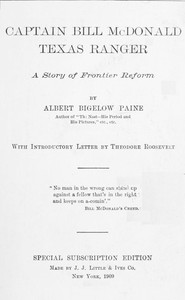
Captain Bill McDonald, Texas Ranger: A Story of Frontier Reform — Background and Themes
(0 User reviews)
1270
Project Gutenberg
2021
Not confirmed
Frontier and pioneer life -- Texas; Texas -- History -- 1846-1950; McDonald, William Jesse, 1852-1918; Texas Rangers -- Biography; Peace officers -- Texas -- Biography; Outlaws -- Texas -- History
Readers of public-domain and historical texts
Project Gutenberg digital edition
en
Edition facts
Words
113,937
Reading time
496 min
Text sections
12
The source record for Captain Bill McDonald, Texas Ranger: A Story of Frontier Reform — Background and Themes measures this digital text at 113,937 words, 8 hr 16 min estimated reading time, and 12 detected text sections.
The text analysis averages about 21.1 words per sentence, while the detected sections provide another way to judge how the source is divided.
Project Gutenberg metadata also associates the work with “Frontier and pioneer life -- Texas,” connecting these edition facts with the source record’s subject description.
Source:
Project Gutenberg record #66849
This editorial note examines how the opening, middle, and later excerpts of Albert Bigelow Paine's biography of Captain Bill McDonald guide a first reading, focusing on McDonald's investigative methods, his creed, and the reform of frontier lawlessness.
Read the complete public-domain text at its original source.
Read on Project GutenbergThe biography opens with McDonald's creed—"No man in the wrong can stand up against a fellow that's in the right and keeps on a-comin'"—immediately establishing his moral certainty and relentless pursuit. The early chapters trace his Mississippi childhood and Texas emigration, emphasizing presence of mind and early reforms. Readers encounter a pattern: McDonald confronts lawlessness with decisive, often solitary action, as when he holds up a bad gang single-handed in No-Man's Land. The excerpts reveal a narrative built around specific episodes, each demonstrating his methods and the frontier's need for reform.
McDonald's Investigative Method
The excerpt from the Athens lynching case showcases McDonald's methodical approach. He examines tracks days after the crime, identifying four distinct trails—five horses, three, two, and one—despite obliterated signs. He declares, "I'm going to stay here till I get it, and I'm going after it just like I was going for a doctor." This line reveals his persistence and the urgency he brings. He assures witnesses they need not fear testifying, promising protection. The narrative details how he builds evidence from known motives: Joe Wilkerson's false accusations against the Humphreys, leading to a lynching. McDonald's work is forensic and psychological, not merely physical.
The Creed in Action
McDonald's creed appears in the table of contents and is echoed in his actions. When warned of a potential ambush, he goes outside with a six-shooter, demanding the caller's business. He recognizes the man as an ex-convict and associates him with a known scoundrel, Bill Holley. This incident illustrates his willingness to face danger directly, relying on his knowledge of criminal networks. The creed is not just a motto but a operational principle: he believes rightness and persistence overcome wrong. The narrative reinforces this through repeated episodes where McDonald, often alone, confronts armed gangs and outlaws, relying on his reputation and resolve.
Frontier Reform as Central Theme
The subtitle "A Story of Frontier Reform" is literal. The excerpts depict a region where law is weak and citizens are terrorized. McDonald's role is to impose order, often through unconventional means. In the Athens case, he works with local officials but takes charge. The narrative describes "Trans-cedar tribunal" justice—a vigilante court that doomed George Humphrey. McDonald's reform is personal: he changes behavior by demonstrating that law enforcement will protect witnesses and punish wrongdoers. The biography's structure, with chapters like "Reforming the Wilderness" and "Cleaning Up the Strip," shows a systematic campaign against lawlessness, not random adventures.
Narrative Voice and Structure
Albert Bigelow Paine writes in a straightforward, anecdotal style, often quoting McDonald directly. The excerpts include dialogue that reveals character: McDonald's bluntness, his use of local knowledge, and his dry humor. The narrative moves chronologically but focuses on set-piece confrontations. Each chapter title signals a specific reform effort, such as "Getting Even with the Brooken Gang" or "New Tactics in No-Man's Land." This structure guides the reader through McDonald's career as a progression of challenges met. The inclusion of a foreword by Theodore Roosevelt adds historical weight, but the text itself remains focused on McDonald's actions and their impact on frontier society.
Readers approaching this biography should attend to the interplay between McDonald's creed and his investigative techniques. The excerpts suggest a man who combines physical courage with careful deduction, and a narrative that values concrete detail over generalization. The book's episodic structure rewards attention to how each reform builds on previous ones. The Athens lynching case, in particular, offers a microcosm of McDonald's methods: patient tracking, witness protection, and a refusal to be intimidated. These elements, traceable in the excerpts, provide a reliable entry point into the full work.
That rainy afternoon, McDonald’s grim arithmetic of frontier justice—every outlaw’s debt settled in lead—left me staring out the window, wondering about civilized courts for wild things. The quiet absurdity of that thought nudged me toward a stranger shelf, where I found The Criminal Prosecution and Capital Punishment of Animals — Reading Companion, its pages full of pigs tried for murder and rats excommunicated. Order, it seems, has always been a peculiar kind of longing.
There are no reviews for this eBook.
There are no comments for this eBook.
Reader reflection
What did you think of this book?
Answer a few questions and save a private reflection on this device.
Your progress
0
/
10
2
How much did you enjoy the reading experience?
3
Would you encourage someone else to read it?
4
How easy was the book to follow?
5
How did the pace of the book feel?
6
How understandable was the text?
7
How useful did the reading feel?
8
Did any part of the book feel personally relevant?
9
What changed or sharpened your thinking?
10