1

The Criminal Prosecution and Capital Punishment of Animals — Reading Companion
(0 User reviews)
1665
Project Gutenberg
2013
Not confirmed
Animals, Prosecution and punishment of -- History; Animals -- Law and legislation -- History; Trials -- Europe
Readers of public-domain and historical texts
Project Gutenberg digital edition
en
Edition facts
Words
90,327
Reading time
393 min
Text sections
10
Before opening The Criminal Prosecution and Capital Punishment of Animals — Reading Companion, the edition data offers a quick orientation: 90,327 words, 6 hr 33 min estimated reading time, and 10 detected text sections.
The text analysis averages about 32.3 words per sentence, while the detected sections provide another way to judge how the source is divided.
Project Gutenberg metadata also associates the work with “Animals, Prosecution and punishment of -- History,” connecting these edition facts with the source record’s subject description.
Source:
Project Gutenberg record #43286
E. P. Evans examines historical legal proceedings against animals, from insects to livestock, analyzing the theological and jurisprudential frameworks that treated beasts as moral agents subject to trial and execution.
Read the complete public-domain text at its original source.
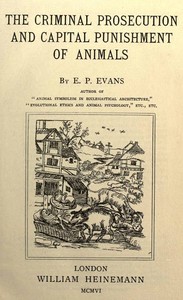
Read on Project GutenbergE. P. Evans opens his study with a striking image: a sow executed in a public square, dressed in human clothes, her piglets present as witnesses. This is not a freakish anecdote but the logical outcome of a legal system that regarded animals as moral persons capable of committing crimes. Evans draws on medieval court records, theological treatises, and folk customs to reconstruct a world where rats were summoned to court, weevils were assigned defense attorneys, and homicidal bees were formally excommunicated.
The book’s structure moves from the grandest ecclesiastical anathemas to the smallest local ordinances, tracing how the same logic that cursed caterpillars in Switzerland also justified deodands—objects forfeited to God after causing a death. Evans is less interested in sensationalism than in the philosophical consistency of these practices, noting how they persisted into the nineteenth century in modified forms.
Rats in the Dock: The Legal Machinery of Animal Trials
The first chapter details the most elaborate animal prosecution on record: a trial of rats in Autun, France, around 1520. Evans reproduces the arguments of Bartholomew Chassenée, the lawyer appointed to defend the rats. Chassenée did not deny that the rats had committed crimes; instead, he argued procedural points: the summons was improperly served because the rats were scattered across many parishes, and the court had not guaranteed safe passage for the defendants, who might be attacked by cats on their way to trial.
Evans notes that Chassenée later wrote a dissertation on the subject, citing Roman law, canon law, and the Bible. The trial dragged on for months, with the court eventually offering the rats a plot of land if they would leave the region. When they refused, the case was referred to a higher court, and the final verdict is lost. Evans uses this episode to illustrate how seriously medieval jurists took the personhood of animals: they were not merely scapegoats but legal subjects with rights.
Excommunication and Anathema: The Church Against Vermin
Evans devotes considerable attention to ecclesiastical curses against pests. In 1120, the Bishop of Lausanne excommunicated the eels and blood-suckers in Lake Leman, a ruling approved by theologians at Heidelberg. The formula of excommunication was the same as for humans: the animals were declared cut off from the Church and denied the sacraments. Evans points out the logical problem: if animals had souls capable of sin, they also had souls capable of salvation, yet no one proposed baptizing them.
He contrasts excommunication with anathema, a more severe curse that could destroy crops or kill insects outright. St. Pirminius was said to have expelled reptiles from an island by anathema, and St. Magnus’s crosier was reputed to have vermifugal powers. Evans treats these stories not as mere superstition but as evidence of a coherent worldview in which the natural world was subject to spiritual jurisdiction.
Deodands and the Price of a Life
The concept of deodand—an object that caused a death and was therefore forfeited to God—occupies a central place in Evans’s analysis. He traces it from Anglo-Saxon law through Blackstone’s Commentaries, arguing that Blackstone’s explanations are “exceedingly vague and unsatisfactory.” The deodand was not a fine for negligence, as Blackstone suggested, nor a charitable donation for the victim’s soul. Instead, it was a form of retribution against the object itself, which was considered tainted by the act of killing.
Evans provides examples: a sword that killed its owner was not to be polished or repaired without a certificate of purification; a beam that fell on a man could be forfeited to his family; a boat from which a fisherman drowned was beached and left to rot. In some German communities, the value of the deodand was split between the state and the victim’s family. Evans notes that this principle survived into the 1890s, when a Bavarian man was convicted of exhuming a child’s body to steal its eye, believing it would make him invisible.
The Persistence of Legal Animism
Evans closes his survey by examining how these medieval ideas lingered into modern times. He cites a 1894 trial in Weiden, Bavaria, where a man was sentenced for grave-robbing based on the belief that a dead child’s eye conferred invisibility—a direct descendant of the deodand logic. He also discusses the Scottish custom of cursing a boat that had drowned its owner, letting it rot on the shore as punishment.
Throughout, Evans maintains a tone of scholarly detachment, but his selection of details reveals a fascination with the human mind’s ability to project moral agency onto inanimate objects and animals. He does not mock these beliefs but treats them as serious attempts to impose order on a chaotic world. The book’s final pages return to the question of personhood, suggesting that the line between human and nonhuman legal subjects is more porous than modern jurisprudence admits.
Evans’s work is best approached as a collection of case studies in legal anthropology rather than a continuous narrative. The chapters can be read independently, though the introduction provides essential context on the theological debates that underpinned animal trials. Readers interested in the history of criminal law will find parallels to modern debates about corporate personhood and the legal status of animals. The book’s value lies not in its conclusions—Evans offers few—but in the extraordinary archive it preserves.
Years at the desk have shown me how authority seeks its quiet measure. That curious old Evans chronicle, with its earnest trials of beasts, always felt a stranger to our law’s gentler foundations. Yet beside this Lectures on the constitution and laws of England With a commentary on Magna Charta, and illustrations of many of the English statutes — Text and Context, they share a solemn belief that order must speak, even to the silent. A passing nod between neighbors.
There are no reviews for this eBook.
There are no comments for this eBook.
Reader reflection
How will you remember this book?
Save your reaction, strongest insight, and memorable passage.
Your progress
0
/
10
2
Did this book hold your interest?
3
How likely are you to recommend this book?
4
How demanding did the text feel?
5
Did this book create an emotional response?
6
Did it raise ideas you would like to talk about?
7
Which part made the strongest impression?
8
Do you expect to return to this book?
9
In one sentence, what did you learn?
10