1

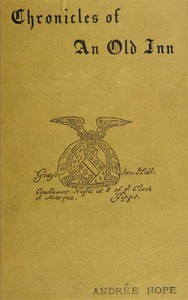
Chronicles of an Old Inn; Or, A Few Words about Gray's Inn — Key Ideas to Explore
(0 User reviews)
1291
Project Gutenberg
2020
Not confirmed
Lawyers -- Great Britain; Inns of Court; Gray's Inn
Readers of public-domain and historical texts
Project Gutenberg digital edition
en
Edition facts
Words
39,904
Reading time
174 min
Text sections
4
The catalog record for Chronicles of an Old Inn; Or, A Few Words about Gray's Inn — Key Ideas to Explore provides practical reading context through 39,904 words, 2 hr 54 min estimated reading time, and 4 detected text sections.
The text analysis averages about 27.9 words per sentence, while the detected sections provide another way to judge how the source is divided.
Project Gutenberg metadata also associates the work with “Lawyers -- Great Britain,” connecting these edition facts with the source record’s subject description.
Source:
Project Gutenberg record #63844
Andrée Hope's 1887 chronicle of Gray's Inn blends architectural description with biographical sketches of its notable members, including Bacon, Burleigh, and Coke. The narrative voice shifts from atmospheric scene-setting to measured historical portraiture, with a preface that frames the work as a personal, incomplete sketch.
Read the complete public-domain text at its original source.
Read on Project GutenbergAndrée Hope opens Chronicles of an Old Inn not with the Inn itself but with the Holborn gateway that leads to it, describing the “low and dark” archway that “echoes and re-echoes with the thunder of the mighty traffic.” The prose immediately establishes a contrast between the clamorous street and the quiet precincts beyond, a spatial tension that recurs throughout the book. Hope’s preface confesses “much diffidence, even with alarm” at publishing this “little book,” which she calls a “rough sketch” written for friends and family, many already deceased. This personal, almost elegiac tone colours the entire work, making clear that the chronicle is as much a memorial as a history.
A Gateway and a Pulse: The Opening’s Urban Rhythm
The first chapter dwells on Holborn as a living artery, “the heart of gigantic London,” through which “the wondrous stream of commerce is for ever flowing.” Hope’s language is deliberately physiological: streets are “arteries,” traffic is a “pulse,” and the city is a body. This metaphor gives way to a close description of the gateway itself, its darkness and noise forming a threshold between public thoroughfare and institutional calm. The passage is notable for its rhythmic repetition—“From early dawn until late into the night”—which mimics the ceaseless motion it describes. The effect is immersive, pulling the reader into the sensory experience of Victorian London before retreating into the Inn’s quieter history.
Burleigh’s Exit: A Set Piece of Measured Dignity
Hope’s account of Lord Burleigh’s final days is the most sustained narrative passage in the excerpts. She reports his last public act—opposing the Earl of Essex’s warlike stance—and his calm retort, “that the noble Lord seemed intent on nothing but blood and slaughter.” The scene is staged with theatrical precision: Burleigh pulls out a prayer-book, points to “Men of blood shall not live out half their days,” and withdraws from public life. Hope then describes his deathbed, surrounded by children, grandchildren, and servants, “calmly and peacefully, about five o’clock in the morning of the 4th of August, 1598.” The prose slows to a stately pace, matching the gravity of the subject. She refrains from inventing dialogue, instead relying on reported speech and documented gestures.
The Biographer’s Voice: Diffidence and Judgment
Throughout the biographical sections, Hope interjects cautious evaluations. Of Burleigh she writes that “men may have differed from him in opinion, they ever acknowledged his honesty of purpose.” She acknowledges that sixteenth-century measures “seem needlessly harsh” to modern readers, but contextualises them within an era when “swords were more readily drawn.” These asides reveal a writer aware of her own historical distance and her audience’s potential scepticism. The preface’s language of “trembling awe” before the literary world recurs implicitly in these hedging phrases. Hope does not claim authority; she offers a “rough sketch” that may “bring persons and places as vividly to remembrance as highly finished pictures.” This self-deprecating frame is consistent across the excerpts, shaping the reader’s expectation of an affectionate, incomplete portrait rather than a definitive history.
Hope’s chronicle moves between two registers: the atmospheric, almost novelistic description of place and the restrained, respectful biographical sketch. Readers attentive to shifts in pace will notice how the prose slows for deathbed scenes and quickens in the opening traffic passage. The book rewards those who treat it as a personal essay in historical clothing—a memorial written “to give pleasure to many dear to the writer’s heart,” as the preface states, rather than a comprehensive institutional record.
That rainy afternoon in the inn’s library, with Bacon’s shadowy portrait watching, I drifted from its legal echoes to a stranger question—how Congress, not a court, gained its post-road authority. Hope’s sketch felt personal, incomplete; The postal power of Congress: A study in constitutional expansion — Reading Companion answered a quiet thread about power and habit. One book simply led to another.
There are no reviews for this eBook.
There are no comments for this eBook.
Reader reflection
Your personal reading reflection
Build a private reading journal entry for this title.
Your progress
0
/
10
2
How did the book work for you overall?
3
How likely are you to recommend this book?
4
What was the reading difficulty like?
5
How clearly were the main ideas presented?
6
What did you appreciate most?
7
How valuable was this book for your own interests?
8
Did you relate to its people, ideas, or situations?
9
What is the main idea you are taking away?
10