1

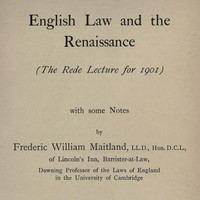
English Law and the Renaissance The Rede Lecture for 1901 — Text and Context
(0 User reviews)
3220
Project Gutenberg
2017
Not confirmed
Law -- England -- History; Renaissance -- England
Readers of public-domain and historical texts
Project Gutenberg digital edition
en
Edition facts
Words
24,127
Reading time
105 min
Text sections
5
The catalog record for English Law and the Renaissance The Rede Lecture for 1901 — Text and Context provides practical reading context through 24,127 words, 1 hr 45 min estimated reading time, and 5 detected text sections.
The text analysis averages about 21.6 words per sentence, while the detected sections provide another way to judge how the source is divided.
Project Gutenberg metadata also associates the work with “Law -- England -- History,” connecting these edition facts with the source record’s subject description.
Source:
Project Gutenberg record #54251
Maitland's 1901 Rede Lecture examines how English law resisted the humanist and Romanizing currents of the Renaissance, focusing on the survival of medieval legal French, the role of the Inns of Court, and the Henrician use of civil law.
Read the complete public-domain text at its original source.
Read on Project GutenbergFrederic William Maitland opens his 1901 Rede Lecture by imagining Sir Robert Rede, the sixteenth-century judge and founder of the lectureship, returning to ask why his successors have said so little about English law. This rhetorical device immediately frames the lecture as a corrective: a study of law’s place in the Renaissance, a period usually associated with humanism and classical revival. Maitland notes that Rede is known today chiefly through his will, not his legal work, and that his judgments survive only in the Year Books, written in “queer old French.” That phrase signals one of Maitland’s central concerns—the persistence of medieval legal language and forms in an age of cultural transformation.
The Language of the Year Books
Maitland draws attention to the linguistic conservatism of English law. The Year Books of Henry VII and Henry VIII, which record Rede’s arguments and judgments, are written in a “queer old French” that seems alien to the humanist spirit of the Renaissance. This choice of language is not merely a curiosity; it reflects a deeper resistance to the classical Latin and polished style that humanists like Erasmus promoted. Maitland implies that English law’s technical vocabulary and its reliance on oral tradition in the Inns of Court insulated it from the textual and philological methods that transformed other disciplines. The law’s archaic French became a badge of professional identity, a barrier to the kind of systematic reform that Roman law models might have encouraged.
Henrician Borrowings from Civil Law
Maitland documents how Henry VIII’s break with Rome created a temporary opening for civil law ideas. He cites a 1543 statute that allowed unordained doctors of civil law to exercise ecclesiastical jurisdiction, calling it “the strongest statement of King Henry’s divinely instituted headship of the church.” The lecture notes that Thomas Starkey urged Reginald Pole to read Marsilius of Padua, whose Defensor Pacis was translated into English in 1535. Maitland observes that the translation did not sell well, despite being “the best book in English against the usurped power of the bishop of Rome.” These examples show that while civil law arguments were useful for royal propaganda, they did not displace the common law’s hold on English legal practice.
The Inns of Court as a Counter-Renaissance
Maitland emphasizes the institutional strength of the Inns of Court, which trained lawyers through apprenticeship and moots rather than university lectures. He notes that the Henrician doctors of law—Tunstall, Gardiner, Bonner, Thirlby, Sampson—were civilians trained at Padua or Cambridge, but they operated in a separate sphere from the common lawyers. The lecture suggests that the Inns’ insularity preserved medieval methods of legal education and argument. Maitland’s evidence includes the careers of these bishops, who held civil law doctorates but whose influence did not transform the common law’s curriculum. The Inns remained a “school of law” in the medieval sense, resistant to the humanist reforms that reshaped other European legal systems.
The Persistence of Bartolism
Maitland closes his argument with a striking comparison: the French jurist Du Moulin, though a Romanist, was in form and substance “the last of the great Bartolists.” This reference to the medieval commentator Bartolus links English law’s conservatism to a broader European pattern. Maitland implies that even where Roman law was adopted, it often retained a scholastic, glossatorial method. The English common law, by contrast, never underwent a Bartolist phase because it never fully received Roman law. Maitland’s lecture thus presents the Renaissance as a missed encounter: English law’s insularity was both a survival of medieval forms and a precondition for its later distinctiveness.
Maitland’s lecture is a model of how to use a single occasion—the Rede Lecture—to open a large historical question. Readers should attend to his method: he moves from a specific text (the Year Books) to institutional practices (the Inns of Court) and then to comparative European examples. The lecture does not claim to be exhaustive; it is a provocative sketch, dense with references that reward further exploration. For those interested in the intersection of legal history and intellectual history, this short work offers a concentrated argument about why English law did not become a Renaissance science.
That rainy afternoon, Maitland’s lecture kept returning to the stubbornness of legal French, how it survived the Renaissance’s clean lines. I found myself thinking of other stubborn things—old opinions, their wooden logic. Later, by sheer accident, I stumbled upon Lumber Legal Opinions — Background and Themes, and it felt like finding the same rain, falling in a different forest.
There are no reviews for this eBook.
There are no comments for this eBook.
Reader reflection
Your personal reading reflection
Build a private reading journal entry for this title.
Your progress
0
/
10
2
Did this book hold your interest?
3
Would you pass this book on to a friend?
4
How demanding did the text feel?
5
Would you start a conversation about this book?
6
How would you rate its originality?
7
How strongly did the book affect you emotionally?
8
How clearly were the main ideas presented?
9
What did this book teach you most?
10