1

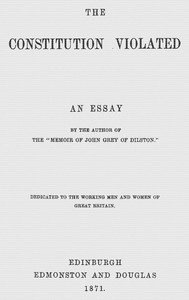
The constitution violated — Key Ideas to Explore
(0 User reviews)
989
Project Gutenberg
2025
Not confirmed
Constitutional law -- Great Britain; Prostitutes -- Legal status, laws, etc. -- Great Britain
Readers of public-domain and historical texts
Project Gutenberg digital edition
en
Edition facts
Words
53,243
Reading time
232 min
Text sections
14
This digital edition of The constitution violated — Key Ideas to Explore is described by source-level measurements including 53,243 words, 3 hr 52 min estimated reading time, and 14 detected text sections.
The text analysis averages about 26.2 words per sentence, while the detected sections provide another way to judge how the source is divided.
Project Gutenberg metadata also associates the work with “Constitutional law -- Great Britain,” connecting these edition facts with the source record’s subject description.
Source:
Project Gutenberg record #76301
Butler's 1871 essay argues that the Contagious Diseases Acts violate English constitutional principles, examining the legislative overreach and its threat to civil liberties through legal and historical analysis.
Read the complete public-domain text at its original source.
Read on Project GutenbergButler opens her essay by declaring that the Contagious Diseases Acts of 1866, 1868, and 1869 are unconstitutional, a charge she supports not through medical or moral arguments but through a detailed examination of English constitutional law. She immediately distinguishes her approach from others, noting that the moral aspect has been 'dwelt upon by the religious portion of the community, almost to the exclusion of others,' while the constitutional dimension remains underexplored. This framing positions her work as a corrective, aiming to 'arouse the country to a sense of that danger' by grounding her critique in legal precedent and political theory.
A Deliberate Narrowing of Focus
Butler explicitly limits her scope to the constitutional aspect, refusing to engage with the Acts' medical efficacy or statistical outcomes. She writes, 'With their medical aspect and the statistical consideration of their results on public health, it is not my intention to deal.' This choice is strategic: by sidestepping empirical debates, she forces readers to confront the Acts as a matter of legal principle. She acknowledges that the moral side 'of necessity includes all others,' yet she insists that the constitutional angle has been neglected. This narrowing allows her to build a case that rests on the structure of English governance rather than on contested data or religious sentiment.
The People's Instinct for Constitutionality
Butler appeals to a popular, almost intuitive understanding of constitutional rights. She notes that 'the mass of the people of England have a strong instinct, if it be nothing more, of what is constitutional and what is not,' citing resolutions passed at public meetings that used the word 'unconstitutional.' She contrasts this instinct with the ignorance of the Acts' framers, suggesting that 'Magna Charta is in everybody's lips but in nobody's hands' applies especially to legislators. By invoking Sir Edward Creasy's claim that the English Constitution 'is susceptible of a full and accurate explanation,' she positions her essay as a remedy for that ignorance, aiming to educate readers on the principles at stake.
The Metaphor of the Worm in the Dyke
Butler employs a striking metaphor to convey the insidious nature of the Acts: 'they all give themselves over for lost when they know that the worm has penetrated into their dykes.' This image of a hidden, internal threat—rather than an external flood—underscores her argument that the danger comes from within the legislative system itself. She amplifies this with Montesquieu's warning about the corruption of legislative power, asking 'with sorrow' whether England has 'already begun to tread this downward path.' The metaphor recurs in her closing sections, reinforcing the idea that the Acts represent a slow erosion of foundational liberties.
Representation and the Will of the Nation
Butler argues that the Contagious Diseases Acts were not made by the nation or even by Parliament, but by 'a mere fraction of Parliament casting off for a time the faith and responsibility of men commissioned by the nation.' She insists that the people, though poorly educated in some cases, 'still know right from wrong' and can 'distinguish between truth and falsehood, between freedom and slavery.' Quoting Lord Chatham on the virtues of the framers of Magna Charta, she contends that government becomes dangerous when it ceases to be 'honestly representative' of the masses. This section ties her constitutional critique to a broader theory of democratic legitimacy, warning that the Acts betray the trust placed in elected officials.
Butler's essay is best read as a legal brief written for a popular audience, blending constitutional analysis with rhetorical appeals to national pride and moral duty. Readers should attend to her use of historical precedent and her careful distinction between the medical, moral, and constitutional dimensions of the Acts. The excerpts do not reveal the full arc of her argument, but they establish her central claim: that the Acts represent a dangerous concentration of executive power achieved through legislative abdication. Her tone is urgent, her evidence drawn from legal authorities and political philosophers, and her target is the conscience of the British public.
Reading Butler’s arguments about how quietly the law can slip into our private lives, I found myself thinking of an old family manuscript, the Autobiography of Charles Clinton Nourse Prepared for use of Members of the Family — Context and Discussion. There was something tender in how he recorded ordinary days, as if he sensed what was worth preserving. We never know which freedoms or small moments become the ones we miss most.
There are no reviews for this eBook.
There are no comments for this eBook.
Reader reflection
What did you think of this book?
Answer a few questions and save a private reflection on this device.
Your progress
0
/
10
2
How much did you enjoy the reading experience?
3
Would you encourage someone else to read it?
4
How easy was the book to follow?
5
Did the book give you something worth debating?
6
Do you expect to return to this book?
7
Was the book easy to understand?
8
Which aspect of the book did you value most?
9
Which lesson or insight stayed with you?
10