1

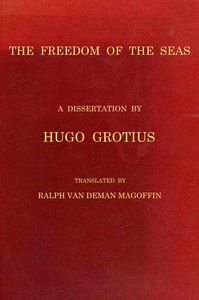
The freedom of the seas — Story, Setting & Ideas
(0 User reviews)
1155
Project Gutenberg
2025
Not confirmed
Freedom of the seas; Law of the sea
Readers of public-domain and historical texts
Project Gutenberg digital edition
en
Edition facts
Words
47,300
Reading time
206 min
Text sections
92
This digital edition of The freedom of the seas — Story, Setting & Ideas is described by source-level measurements including 47,300 words, 3 hr 26 min estimated reading time, and 92 detected text sections.
The text analysis averages about 20.9 words per sentence, while the detected sections provide another way to judge how the source is divided.
Project Gutenberg metadata also associates the work with “Freedom of the seas,” connecting these edition facts with the source record’s subject description.
Source:
Project Gutenberg record #75962
Hugo Grotius's 1608 Latin tractate, translated and annotated, arguing for Dutch rights to East Indian trade and establishing foundational principles of maritime law. This edition presents the original Latin and English translation side by side, with extensive footnotes and translator's notes clarifying legal and historical context.
Read the complete public-domain text at its original source.
Read on Project GutenbergThis edition of Hugo Grotius's Mare Liberum (1608) presents the Latin text of the 1633 printing alongside a 1916 English translation by Ralph Van Deman Magoffin, with an introductory note by editor James Brown Scott. The work was originally published anonymously to advocate for Dutch participation in East Indian trade, arguing that the sea is common to all and cannot be possessed by any nation. The translation carefully maintains the meaning of the original Latin while clarifying its context, and the side-by-side layout allows readers to compare the two versions directly. The text includes 192 footnotes for each language version, plus 17 translator's notes placed at paragraph ends, offering detailed commentary on legal references and historical background.
A Dual-Language Structure and Its Implications
The most distinctive feature of this edition is its presentation of Latin and English on facing pages, a format that invites close comparison. The Latin text, based on a 1633 printing, is not the original 1608 version but a later revision, which the translator notes in his preface. The English translation, while faithful, often expands or clarifies Grotius's dense legal prose. For instance, where the Latin uses the term ius prohibendi, the English renders it as “the right to prevent” and adds explanatory phrases about occupation and prescription. This dual-language structure reveals how translation choices shape interpretation: the English version tends to make explicit what the Latin leaves implicit, particularly in passages dealing with Roman law citations. Readers interested in the evolution of legal terminology will find the facing-page format a valuable tool for tracing how Grotius's arguments were adapted for an early twentieth-century audience.
The Role of Roman Law and Scholarly Authority
Grotius builds his argument on a foundation of Roman legal authorities, citing Papinian, Marcianus, and other jurists to support the principle that the sea cannot be owned. The excerpts show him engaging with earlier commentators like Angeli, Johannes, Bartolus, and Castrensis, often correcting or dismissing their interpretations. For example, he rejects Angeli's claim that Venice and Genoa could acquire rights to adjacent gulfs by prescription, arguing that such a view either “are mistaken, or are deceiving others.” This combative tone is characteristic of Grotius's method: he marshals legal precedents not as neutral sources but as weapons in a polemical battle. The footnotes, which are extensive and placed at the end of the book, provide modern readers with references to the original Roman texts and later commentaries, making the work accessible to those unfamiliar with early modern legal scholarship. The translator's notes, marked with asterisks or daggers, offer additional clarifications on points of translation or historical context.
Pace and Persuasion: From Abstract Principle to Concrete Example
The argument moves from broad philosophical claims about the sea as a common good to specific legal examples, a shift that affects the pace of the text. Early sections proclaim the sea's freedom in sweeping terms, but later passages narrow to technical discussions of prescription and occupation. In the excerpt, Grotius cites Papinian's example of a building on a shore to illustrate that occupation only grants rights while it lasts; if the building is destroyed, the right lapses. He then extends this analogy to fishing in a river branch, arguing that even a thousand years of continuous use does not create a permanent right if occupation ceases. This method of moving from abstract principle to concrete case slows the reading, requiring careful attention to legal distinctions. The translator's decision to include the original Latin alongside the English further alters pace, as readers may pause to compare phrases. The work rewards those who read slowly, tracing how Grotius builds his case through cumulative examples and refutations of opposing views.
Readers approaching this edition should be prepared for a text that is as much a legal brief as a philosophical treatise. The side-by-side Latin and English invite a comparative reading, while the extensive footnotes and translator's notes provide essential context for understanding Grotius's references to Roman law and contemporary debates. Pay particular attention to the way Grotius uses hypothetical examples—such as the building on the shore or the fisherman in the river branch—to illustrate abstract principles. These examples are not merely illustrative but central to his argumentative strategy, grounding his claims in concrete, imaginable situations.
There are days I remember Grotius wrestling with the sea’s openness, his careful Latin shaping order from salt spray. Beside him on my shelf sits a humbler volume, Ifugao Law (In American Archaeology and Ethnology, Vol. 15, No. 1) — Background and Themes, and I think both knew—long ago and far apart—that custom, not conquest, holds a people’s peace.
There are no reviews for this eBook.
There are no comments for this eBook.
Reader reflection
How will you remember this book?
Save your reaction, strongest insight, and memorable passage.
Your progress
0
/
10
2
What was your overall reaction to the book?
3
Is this a title you would suggest to others?
4
How easy was the book to follow?
5
How did the reading compare with what you expected?
6
Did the story or argument move comfortably?
7
How strong was your personal connection to the text?
8
Which aspect of the book did you value most?
9
What did this book teach you most?
10