1

The Law and Medical Men — Context and Discussion
(0 User reviews)
2703
Project Gutenberg
2016
Not confirmed
Medical laws and legislation
Readers of public-domain and historical texts
Project Gutenberg digital edition
en
Edition facts
Words
68,508
Reading time
298 min
Text sections
26
The Law and Medical Men — Context and Discussion can be approached with a clearer sense of reading commitment from its source measurements: 68,508 words, 4 hr 58 min estimated reading time, and 26 detected text sections.
The text analysis averages about 15.5 words per sentence, while the detected sections provide another way to judge how the source is divided.
Project Gutenberg metadata also associates the work with “Medical laws and legislation,” connecting these edition facts with the source record’s subject description.
Source:
Project Gutenberg record #51293
A legal primer on the intersection of medicine and law, citing case law on fees, malpractice, expert testimony, and professional boundaries, written by a Canadian barrister in 1884.
Read the complete public-domain text at its original source.
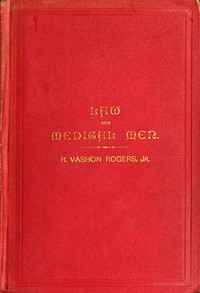
Read on Project GutenbergR. Vashon Rogers, Jr., a barrister of Osgoode Hall, opens this 1884 work by identifying a gap in the libraries of both legal and medical practitioners. He positions the book as a primer, not an encyclopedia, and emphasizes that he has largely reproduced the words of judges and reporters rather than advancing his own theories. The preface’s diffident tone—committing the work to the critics who wield “the pen, the tongue and the scalpel”—signals a careful, evidence-based approach. The table of contents reveals fifteen chapters covering fees, malpractice, professional evidence, experts in insanity cases, defamation, dissection, dentists, and druggists, among others. Rogers’s voice is that of a compiler, letting judicial opinions and case citations carry the argument.
The Compiler’s Voice and the Weight of Precedent
Rogers repeatedly stresses that he is an “humble compiler and citer of cases,” a stance that shapes the book’s structure. The text is dense with references: the table of cases cited runs from Abernethy v. Hutchinson to an unnamed “Anon” case. In the excerpt on expert testimony, Rogers quotes the Supreme Court of Indiana admitting that no precise test exists for determining an expert’s competence, leaving it to the court’s discretion. He then cites Ordronaux on the maxim Cuilibet in sua arte perito credendum est—trust the skilled person in their own art. This reliance on quoted authority gives the work a measured, almost judicial rhythm, but also means that strong opinions are attributed to others, not to Rogers himself.
Expert Testimony: Boundaries and Discretion
The chapter on medical experts reveals a nuanced view of who may testify. Rogers notes that a priest who studied physiology and psychology to assess communicants’ mental states was permitted to speak on a woman’s last illness. Yet a physician who treated the insane for thirty years could not testify on the mental capacity of a non-insane dying person. The Kentucky Court of Appeal, quoted by Rogers, ruled that opinions not founded on science but on “a mere theory of morals or ethics” are inadmissible—even physicians cannot claim that no sane Christian would commit suicide. The jury weighs expert testimony, but the judge decides competence. Rogers presents these distinctions without overt commentary, letting the cases speak for themselves.
A Primer’s Scope: From Fees to Resurrectionists
The book’s range is broad but deliberately limited. Chapters on dentists and druggists are included because of their “intimate connection” with medicine. The chapter on dissection and resurrection (Chapter XII) touches on the legal and ethical boundaries of body procurement, a topic that would have been live in the 1880s. Rogers does not moralize; he cites cases and statutes. The work is intended to be “suggestive rather than exhaustive,” a tool for consultation rather than a treatise. This modesty of scope is consistent with the preface’s claim that the book will not obviate the need for conferences between physicians and lawyers—it is a starting point, not a final word.
Readers should approach this text as a period-specific reference work, not a narrative. The value lies in the accumulation of case law and judicial reasoning from the late 19th century, filtered through a Canadian legal lens. The excerpts suggest that Rogers’s own opinions are scarce; the book’s authority derives from the judges he cites. For those interested in the historical interplay of law and medicine, this primer offers a snapshot of how courts defined professional competence, negligence, and the limits of expert testimony before the modern era of evidence rules.
Holding this old primer on doctors and lawyers, I thought of my grandfather’s ledgers, his careful fees and cross-examinations. The same feeling came when I first opened The Visigothic code — Text and Context — another world where rules tried to tame human bodies and disputes. Both books feel like quiet rooms full of old arguments, waiting for someone to listen.
There are no reviews for this eBook.
There are no comments for this eBook.
Reader reflection
Your personal reading reflection
Build a private reading journal entry for this title.
Your progress
0
/
10
2
How did the book work for you overall?
3
Would you encourage someone else to read it?
4
Did the language feel accessible?
5
Did the story or argument move comfortably?
6
Did the book give you something worth debating?
7
How distinctive were its ideas or approach?
8
How useful did the reading feel?
9
What did this book teach you most?
10