1

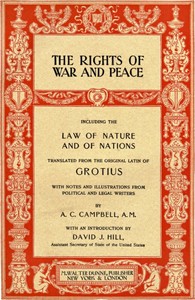
The Rights of War and Peace — Reading Companion
(0 User reviews)
515
Project Gutenberg
2014
Not confirmed
War (International law); International law; Natural law
Readers of public-domain and historical texts
Project Gutenberg digital edition
en
Edition facts
Words
173,308
Reading time
754 min
Text sections
17
This digital edition of The Rights of War and Peace — Reading Companion is described by source-level measurements including 173,308 words, 12 hr 34 min estimated reading time, and 17 detected text sections.
The text analysis averages about 29.1 words per sentence, while the detected sections provide another way to judge how the source is divided.
Project Gutenberg metadata also associates the work with “War (International law),” connecting these edition facts with the source record’s subject description.
Source:
Project Gutenberg record #46564
Hugo Grotius's foundational treatise on just war theory, natural law, and punishment, translated by A.C. Campbell with an introduction by David Jayne Hill. This edition, part of the Universal Classics Library, includes editorial apparatus and scholarly notes.
Read the complete public-domain text at its original source.
Read on Project GutenbergHugo Grotius's The Rights of War and Peace (1625) is a foundational text in international law, systematically arguing that war is justified only as a remedy for injury or as punishment. This English translation by A.C. Campbell, part of the Universal Classics Library, includes an introduction by diplomat David Jayne Hill and extensive chapter summaries. The excerpts reveal a work deeply engaged with classical and biblical sources, citing Plutarch and the Decalogue, and distinguishing natural law from civil customs and divine voluntary law.
Structure and Scope of the Argument
The excerpts show Grotius organizing his treatise around a two-fold classification of just causes for war: reparation for injuries and punishment. The latter receives more detailed treatment, with Grotius defining punishment as 'the pain of suffering, which is inflicted for evil actions.' He carefully distinguishes punishment from mere inconveniences like quarantine, which he says are 'not to be strictly taken for punishments.' The chapter summaries list dozens of sub-questions, from whether internal acts are punishable by man to whether war can be undertaken to punish impiety. This systematic, almost scholastic structure suggests a work intended to leave no logical stone unturned.
Grotius's Use of Sources and Precedents
Grotius grounds his arguments in a wide array of authorities. The excerpts mention 'the ancient Philosophers' and the 'law of Rhadamanthus'—a reference to the mythical judge of the underworld—to support the maxim that one should suffer evil proportional to what one has done. He also engages with Jewish and Roman practices regarding punishment, and repeatedly invokes the Gospel to address objections based on mercy. The translator's footnotes, mentioned in the front matter, likely expand on these references. This interweaving of classical, biblical, and legal sources is characteristic of early modern natural law theory.
The Edition's Paratextual Apparatus
This edition is part of the 'Universal Classics Library,' a series that aimed to present 'the best in History, Philosophy and Literature' with scholarly introductions. The front matter lists an editorial council including presidents of five universities and contributors like Richard Garnett and Léon Vallée. David Jayne Hill's introduction is described as 'brilliant and luminous.' The translator's notes indicate that several chapters were omitted from this English translation, with reasons given in footnotes. Greek words are transliterated in curly braces. Readers should be aware that this is an abridged version, and the omitted material may affect the completeness of Grotius's argument.
Readers approaching this text should note that it is a work of legal philosophy, not a narrative. The dense chapter summaries can serve as a roadmap. Pay attention to Grotius's distinctions—between natural law and civil law, between punishment and other hardships—as they are central to his argument. The edition's scholarly apparatus, including Hill's introduction and the translator's notes, provides valuable context for understanding Grotius's place in the development of international law.
Some evenings, I still think about Grotius’s careful weighing of when harm becomes justice—it left a quiet weight in me. That same patient, almost reverent attention to rules we choose to live by lingers in The Principles of Masonic Law A Treatise on the Constitutional Laws, Usages and Landmarks of Freemasonry — A Reader’s Guide, like a familiar room you return to without knocking. It feels less like reading and more like remembering something older.
There are no reviews for this eBook.
There are no comments for this eBook.
Reader reflection
Your personal reading reflection
Build a private reading journal entry for this title.
Your progress
0
/
10
2
How did the book work for you overall?
3
Is this a title you would suggest to others?
4
Did the language feel accessible?
5
What did you appreciate most?
6
Was the book moving at the right speed?
7
Is this a title worth rereading?
8
Would this book work well in a reading group?
9
What changed or sharpened your thinking?
10