1

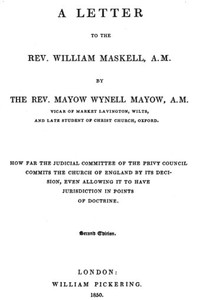
A Letter to the Rev. William Maskell, A.M. How far the Judicial Committee of the Privy Council commits the Church of England by its decision, even allowing it to have — Themes and Context
(0 User reviews)
69
Project Gutenberg
2017
Not confirmed
Church and state -- Great Britain; Church and state -- Church of England; Baptism -- Church of England; Gorham, George Cornelius; Great Britain. Privy Council. Judicial Committee; Ecclesiastical law -- England -- History -- 19th century
Readers of public-domain and historical texts
Project Gutenberg digital edition
en
Edition facts
Words
9,336
Reading time
41 min
Text sections
1
This digital edition of A Letter to the Rev. William Maskell, A.M. How far the Judicial Committee of the Privy Council commits the Church of England by its decision, even allowing it to have — Themes and Context is described by source-level measurements including 9,336 words, 41 min estimated reading time, and 1 detected text section.
The text analysis averages about 33.2 words per sentence, while the detected sections provide another way to judge how the source is divided.
Project Gutenberg metadata also associates the work with “Church and state -- Great Britain,” connecting these edition facts with the source record’s subject description.
Source:
Project Gutenberg record #54269
A mid-19th-century theological pamphlet by Mayow Wynell Mayow addressing the Rev. William Maskell on the implications of the Privy Council's jurisdiction in doctrinal matters, using the Gorham case and baptismal regeneration as a focal point to explore church-state tensions.
Read the complete public-domain text at its original source.
Read on Project GutenbergMayow Wynell Mayow opens his letter by framing the present moment as one of “perilous times,” a phrase drawn from Scripture that immediately signals the gravity of the ecclesiastical dispute at hand. Writing to the Rev. William Maskell, Mayow acknowledges the risk of presumption in commenting on Maskell’s recent letter, yet insists that the crisis demands such boldness. He explicitly declines to offer a full rebuttal, instead focusing on a single point he believes Maskell has overlooked: the question of how far the Judicial Committee of the Privy Council’s decision commits the Church of England, even if one grants its jurisdiction over doctrine. This narrow, precise focus distinguishes the work from broader polemics of the period.
The Argument from Parliamentary Analogy
Mayow develops a striking analogy between the Church’s predicament and a hypothetical parliamentary error in factory legislation. He imagines a bill intended to protect factory children that, due to ambiguous wording, is later interpreted to permit cruelty. If Parliament, knowing this, refuses to correct the ambiguity, it would be complicit in the cruelty. Similarly, he argues, if the Church of England allows an heretical interpretation of its formularies—specifically regarding baptismal regeneration—to stand uncorrected, it adopts that heresy. The analogy is carefully hedged: Mayow notes that the original framers might have been innocent of heretical intent, just as Lord Ashley and Mr. Fielden were not cruel. Yet the present generation’s inaction would still condemn it. This rhetorical move allows Mayow to criticize the Church’s current leadership without impugning earlier divines.
The Church’s Limited Freedom and the Call for Convocation
Mayow starkly contrasts the State’s power to revise its laws with the Church’s inability to act independently: “The Church (among us) alas! has no freedom of speech: no direct power of action.” He argues that the only remedy is for the Church to petition the Crown to license convocation—a synod—to address the doctrinal ambiguities exposed by the Privy Council’s impending decision. Notably, he insists that this step is necessary regardless of what the decision actually is, because the mere possibility of heresy being admitted demands a clear ecclesiastical response. He urges clergy and laity alike to meet in London for this specific purpose, framing the petition as both a duty and a test of the Church’s integrity. The language is urgent but measured, avoiding outright defiance of royal authority.
Suspending Judgment Until the Church Acts
A distinctive feature of Mayow’s argument is his call to suspend final judgment on whether the Church is committed to heresy until it has had the opportunity to respond. He writes, “I think any one of us may, nay every one of us should, suspend our judgment as to her being committed to heresy until we see what it is she will do.” This is not a passive waiting but an active exhortation: the Church must do all it can, and only then can its culpability be assessed. Mayow’s phrasing echoes legal reasoning, treating the Church as a corporate body whose actions—or inaction—will determine its moral and theological standing. The letter thus functions as both a theological argument and a practical call to ecclesiastical action, rooted in a careful analysis of responsibility and ambiguity.
Readers approaching this letter should note its precise historical context: the Gorham judgment (1850) on baptismal regeneration, which sparked intense debate over the relationship between church and state. Mayow’s pamphlet is one of many responses, but its focus on the mechanics of commitment—how a church becomes bound by a court’s interpretation—offers a distinctive angle. The letter rewards attention to its analogical reasoning and its careful distinction between past intent and present responsibility. Those unfamiliar with the details of the case may wish to consult a brief summary of the Gorham controversy before reading.
I found myself thinking about that old pamphlet, the way it quietly wrestles with who gets to decide what a church truly believes. It stayed with me, that tension between law and faith. It reminded me of another book with that same lingering pull, Legal Lore: Curiosities of Law and Lawyers — Text and Context. Strange how old arguments about authority can feel so personal.
There are no reviews for this eBook.
There are no comments for this eBook.
Reader reflection
How will you remember this book?
Save your reaction, strongest insight, and memorable passage.
Your progress
0
/
10
2
How much did you enjoy the reading experience?
3
Would you recommend this book to another reader?
4
How easy was the book to follow?
5
Did anything about the book feel genuinely new?
6
Did it raise ideas you would like to talk about?
7
How valuable was this book for your own interests?
8
Is this a title worth rereading?
9
Which lesson or insight stayed with you?
10