1

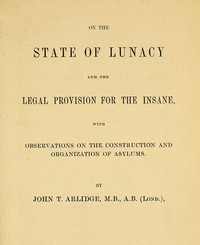
On the State of Lunacy and the Legal Provision for the Insane With Observations on the Construction and Organization of Asylums — Reading Companion
(0 User reviews)
155
Project Gutenberg
2013
Not confirmed
Psychiatric hospitals -- Great Britain; Psychiatric epidemiology; Mental health services -- Great Britain; Insanity (Law) -- Great Britain; Mentally ill -- Care -- Great Britain; Psychology, Pathological -- Epidemiology
Readers of public-domain and historical texts
Project Gutenberg digital edition
en
Edition facts
Words
105,125
Reading time
458 min
Text sections
10
The source record for On the State of Lunacy and the Legal Provision for the Insane With Observations on the Construction and Organization of Asylums — Reading Companion measures this digital text at 105,125 words, 7 hr 38 min estimated reading time, and 10 detected text sections.
The text analysis averages about 35.2 words per sentence, while the detected sections provide another way to judge how the source is divided.
Project Gutenberg metadata also associates the work with “Psychiatric hospitals -- Great Britain,” connecting these edition facts with the source record’s subject description.
Source:
Project Gutenberg record #44320
A physician's 1859 critique of asylum construction, staffing, and medical oversight, based on his experience as superintendent of St. Luke's Hospital. Arlidge argues that large asylums hinder recovery, using detailed observations of attendants' training, ward routines, and the diagnostic limitations of non-medical staff.
Read the complete public-domain text at its original source.
Read on Project GutenbergJohn T. Arlidge opens his treatise with a frank admission: he feels some embarrassment in justifying yet another book on lunacy. Yet he quickly establishes that his work fills a gap, addressing subjects that had not been placed before the public in the same manner. The preface situates the book within a parliamentary inquiry into lunacy laws, giving it a policy-driven urgency. Arlidge writes as a former medical superintendent of St. Luke's Hospital, and his voice is that of a clinician who has watched the daily workings of asylums from the inside. He does not merely catalogue defects; he traces them to specific structural and human failures, from the layout of wards to the social origins of attendants.
The Attendant's Limited Gaze
Arlidge devotes considerable attention to the asylum attendant, whom he portrays not as a villain but as a product of low wages and minimal training. He notes that female attendants are often young women with no nursing experience, drawn from the same class that supplies housemaids. Their education offers no security for patience or sympathy. More pointedly, Arlidge argues that attendants lack the medical eyes to detect early symptoms of disease. A patient may be gravely ill yet make no complaint, and the uninstructed observer will see nothing amiss. The result is that physical illness steals a march on the doctor, taking firm hold before it is noticed. This is not a moral failing but a systemic one: the attendant's role is defined by cleanliness and order, not by clinical observation.
The Superintendent's Mile-Long Rounds
Arlidge paints a vivid picture of the medical superintendent's daily routine in a large asylum. He walks a mile or more of wards, entering each one, asking the attendant if there is anything to report, glancing at floors and beds, bidding good morning to patients, and moving on. The description is almost mechanical: the superintendent depends entirely on attendants for reports, but those attendants lack medical training. Arlidge does not blame the superintendent; he blames the scale. In a colossal asylum, individual interest in patients is all but dead. Inmates become automatons, acted upon by the rules of a great machine. The passage is striking for its concrete detail—the mile of wards, the inspection of bedding, the formulaic greetings—and for its implicit argument that size itself is an obstacle to care.
Disease Masked by Mental Disorder
One of Arlidge's more subtle observations concerns the difficulty of diagnosing physical illness in patients whose minds are disordered. He notes that even when the mind is not imbecile or weighed down by apathy, the features of mental disorder interfere with the interpretation of symptoms. The patient may not complain, or may complain in ways that are misunderstood. The non-professional looker-on sees nothing, and even the medical examiner finds diagnosis difficult. Arlidge here touches on a problem that remains central to psychiatric medicine: the interplay between mental and physical symptoms. He does not offer a solution, but he identifies the problem with precision, grounding it in the everyday experience of asylum practice.
Arlidge's book is not a polemic but a detailed, evidence-based argument for reform. Readers will find its value in the specific observations—the attendant's lack of training, the superintendent's rushed rounds, the masking of disease by mental disorder—rather than in broad pronouncements. The excerpts suggest a work that moves from general statistics to minute particulars of asylum life, and that shift in scale is itself part of Arlidge's method. To read him is to watch a physician think through the problem of institutional care, one ward at a time.
Dr. Arlidge’s plea for smaller, kinder rooms always puts me in mind of a traveller’s quiet rights, so gently traced in The law of the road; or, wrongs and rights of a traveller — Inside the Classic. Both volumes whisper of dignity amidst regulations. One guards the mind’s weary lodgers; the other, the wayfarer’s weary feet. Odd, how a ward and a highway ask the same simple boon: a little space to breathe. Decades among these shelves have taught me that kinship. They share a patient soul.
There are no reviews for this eBook.
There are no comments for this eBook.
Reader reflection
Your personal reading reflection
Build a private reading journal entry for this title.
Your progress
0
/
10
2
How did the book work for you overall?
3
Is this a title you would suggest to others?
4
How demanding did the text feel?
5
Could you see yourself revisiting this book?
6
Did the book deliver what you hoped for?
7
Would you start a conversation about this book?
8
Could you follow the author’s main argument?
9
What did this book teach you most?
10