1

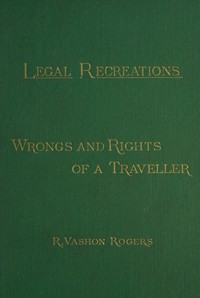
The law of the road; or, wrongs and rights of a traveller — Inside the Classic
(0 User reviews)
1548
Project Gutenberg
2022
Not confirmed
Travel; Carriers -- Canada; Carriers -- United States; Highway law -- Canada; Highway law -- United States; Railroad law -- Canada; Railroad law -- United States
Readers of public-domain and historical texts
Project Gutenberg digital edition
en
Edition facts
Words
70,675
Reading time
308 min
Text sections
24
For The law of the road; or, wrongs and rights of a traveller — Inside the Classic, the stored edition analysis reports 70,675 words, 5 hr 8 min estimated reading time, and 24 detected text sections.
The text analysis averages about 16.3 words per sentence, while the detected sections provide another way to judge how the source is divided.
Project Gutenberg metadata also associates the work with “Travel,” connecting these edition facts with the source record’s subject description.
Source:
Project Gutenberg record #69664
Rogers blends legal exposition with humorous travel anecdotes in this 1876 guide to carrier and passenger rights. The preface promises instruction and entertainment, while excerpts show a conversational narrator, footnoted case law, and vivid scenes like a platform mishap. A unique hybrid of law book and picaresque sketch.
Read the complete public-domain text at its original source.
Read on Project GutenbergR. Vashon Rogers, Jr., a barrister of Osgoode Hall, opens his 1876 work with a preface that frankly disclaims originality: the substance is drawn from Redfield, Chitty, Story, and other authorities. Yet the book’s novelty lies in its stated aim to “combine instruction with entertainment” for a reader in a railway carriage or on a steamboat. The text alternates between plain-language summaries of legal principles and footnoted citations—a “cloud of authorities” for professionals—while the main narrative adopts a conversational, occasionally self-deprecating tone. Rogers likens himself to Uriah Heep, “very ’umble,” and hopes readers will forgive errors, quoting Lord Thurlow on Mansfield.
A Hybrid Form: Legal Digest Meets Travel Sketch
The excerpts reveal a work that defies easy classification. Chapter X, “Platforms and Alighting,” begins with a dialogue between the narrator and a friend, then shifts into a description of passengers rushing off a train at a refreshment stop. The narrator describes a hole in the platform that causes a passenger to suffer “a severe contusion of the integuments under the left orbit”—which the judge later calls “a black eye.” This anecdote is immediately followed by a legal citation (footnote 413) asserting passengers’ rights to safe ingress and egress at intermediate stations. The pattern recurs: a vivid, sometimes humorous scene is anchored by a legal rule, then supported by case references. The effect is a reading experience that moves between storytelling and statutory analysis, each section functioning as a miniature brief illustrated by a fictional or reported incident.
The Narrator’s Voice and the Reader’s Role
Rogers addresses two audiences simultaneously. For the general reader, he adopts a genial, occasionally ironic persona: the narrator describes tea as “a scalding decoction dignified by the name of tea,” and notes that night’s “sable mantle (she has no other except for moonlight wear).” These asides lighten the legal material. For the professional reader, the footnotes—numbering over four hundred in the excerpts—provide a dense apparatus of Anglo-American and Canadian case law. The preface explicitly states that notes, index, and list of cases are “inserted for the special delectation of the professional reader.” This dual address means that a first-time reader may choose to follow the main text for narrative flow, or pause to examine the legal citations. The book does not require continuous reading; its structure invites browsing by topic or by case.
Evidence of Scope: Carriers, Passengers, and Jurisdictions
The catalog subjects list travel, carriers, and highway and railroad law for both Canada and the United States. The preface confirms the book is “written in Ontario” but intended to be “applicable to all parts of the Dominion, as well as to the United States and England.” The excerpts bear this out: Chapter X cites cases from Indiana, South Carolina, Vermont, Massachusetts, Rhode Island, Maryland, Illinois, Pennsylvania, Connecticut, Maine, and Ontario, among others. The legal principles discussed—duty to provide safe platforms, liability for injuries during alighting—are illustrated with examples that cross national borders. A reader interested in the historical development of carrier liability in the late nineteenth century will find a comparative snapshot, though the excerpts do not reveal whether Rogers systematically contrasts the three jurisdictions or merely assembles parallel authorities.
What the Excerpts Do Not Reveal
The available text covers only the preface, part of Chapter X, and the closing Project Gutenberg boilerplate. The full table of contents, other chapters, and the index are absent. It is unclear how many chapters the book contains, whether the narrative frame of the two travellers recurs throughout, or how the legal topics are sequenced. The preface mentions “elegant extracts from ponderous legal tomes” and “gems from the rich mines of legal lore,” but the excerpts do not show whether these extracts are set off typographically or woven into the narrator’s commentary. Readers should not assume that the humorous tone of Chapter X is maintained in every chapter; some sections may be more technical. The book’s subtitle, “Wrongs and Rights of a Traveller,” suggests a focus on passenger remedies, but the full range of carrier duties—baggage, delay, tickets, and so on—is not sampled here.
Approach The Law of the Road as a period piece that documents how law was popularized for a mobile Victorian audience. The book rewards both sequential reading and targeted reference. For a first reading, follow the main narrative and note how each legal point emerges from a concrete situation; the footnotes can be consulted later. The work’s value lies less in doctrinal novelty than in its method of embedding legal rules within the texture of everyday travel—a method that makes the law accessible without sacrificing precision.
Reading about Rogers’s platform mishap, I was back on a foggy train platform decades ago, waiting and wondering. That same mingled irritation and fondness. Chronicles of an Old Inn; Or, A Few Words about Gray's Inn — Key Ideas to Explore once gave me that quiet warmth, a sense of place holding both law and human clumsiness together, like an old clock ticking through someone else’s story.
There are no reviews for this eBook.
There are no comments for this eBook.
Reader reflection
How did this book work for you?
Your answers remain private and are stored only in this browser.
Your progress
0
/
10
2
What was your overall reaction to the book?
3
Would you encourage someone else to read it?
4
How demanding did the text feel?
5
How clear did the writing feel?
6
Did you gain anything practical from the text?
7
Did you relate to its people, ideas, or situations?
8
Was the book moving at the right speed?
9
What did this book teach you most?
10